Introduction
Addiction is a disease caused by addiction to drugs or psychedelic drugs [1]. Currently, the problem of drug addiction is increasing due to the speed of drug release, the presence of drugs in the market, the increase in volume, the distribution of synthetic psychedelic drugs and the prevalence of simultaneous use of several drugs [2]. Reports in this field show that 296 million people have consumed drugs in the world and 39.5 million people have reached the stage of addiction and 494 thousand people have died due to the direct or indirect effects of addiction [3]. Tobacco consumption is one of the most important public health concerns for consumers as well as for society [4]. Tobacco use often begins in early adulthood. Globally, tobacco consumption is recognized as an important risk factor for non-contagious diseases and increased mortality. Drug addiction is a complex disease that is influenced by several genetic and environmental factors [5]. Drug addiction is one of the problems that has had a serious negative impact on the lives of people around the world for many years [6]. Addiction is a complex and progressive disease that can cause physical and mental problems in many aspects of people's lives [7]. In terms of neuroscience, reward regions of the brain, neural adaptations, genetic and epigenetic interactions (which increase transcription or suppress multiple genomes), induce different addiction phenotypes for different durations [8]. Addictive use of drugs causes epigenetic changes and similarly, epigenetic changes caused by the environment can also cause addiction [9]. Addiction is influenced by multiple genetic, epigenetic, molecular and neuroendocrine mechanisms, environmental influences, behavioral, cognitive, emotional and motivational conditions and brain responses to reward and stress cues [10].
The purpose of this research is to identify the influencing factors on drug addiction among teenagers and young adults [11]. Although addiction and its phenotypes are related to different genomes, environmental factors affecting addiction include family conditions, physical abuse, emotional and sexual abuse, peer pressure, disease conditions, etc. There are reports regarding the significant relationship of addiction with gender, age and ethnicity while social and economic status, poor academic progress, religion and marital status also have different degrees of relationship with addiction [12]. Exposure to drugs causes expression changes in multiple genomes through epigenetic mechanisms in different brain regions [13]. This condition is associated with changes in the structure, function and nervous circuit [14]. These changes persist for long periods of time (months or years). Familial connections, genetic vulnerability, neuroendocrine changes and behaviors related to the onset of addiction are affected by epigenetic changes in protective polymorphisms and disturbances in endogenous, monoaminergic, oxytonergic and pituitary stress response systems [15]. Drug use often begins in adolescence, putting young people at risk for fatal overdose and Substance Use Disorders (SUD) in adulthood [16]. Understanding the reported motivations and identifying factors affecting the tendency of young people and adolescents to use alcohol and other drugs as well as the people who use them together, can provide strategies to prevent or reduce drug use and its related consequences among young people and adolescents [17]. Therefore, it is very important to carry out research related to the identification of factors affecting the tendency to drugs among teenagers and young people. These researches help to identify various factors that can cause the tendency to drugs in this age group and to take appropriate measures to prevent this issue. By carefully analyzing these factors, policies, programs and preventive and therapeutic activities can be helped to reduce the risk of drug addiction in society. Also this research can help in early diagnosis and dealing with problems caused by drug use. Therefore, research in this field is very necessary and valuable.
Human society has faced the problem of addiction for centuries and now, due to the expansion of communication and the increase in human population, almost everywhere in the world is facing this destructive phenomenon. Research shows that the tendency to addiction and drugs has wide reasons. Darvishi and Asadolahi have described numerous individual, family and environmental factors in the formation and orientation of youth behaviors in the tendency to use drugs. Hosseini and Hojatiniko investigated the effect of lack of life skills, relationship with inappropriate peers and friends, self-efficacy, religion, parenting style, impulsivity, resilience, mental vitality, perfectionism, self-confidence, metacognitive beliefs and perceived stress on drug use. Abdulahi and Darabi have described the influence of environmental factors and family factors on the tendency of teenagers and young people to use drugs and psychedelic drugs as important. According to the literature of this field, many factors influence people's tendency to drugs. Despite these appropriate classifications of factors affecting the tendency of teenagers and young people to use drugs so far in no research, the factors affecting the tendency of teenagers and young people to use drugs have not been analyzed and categorized according to quitting addiction experts. On the other hand, which factor or factors are very important in the tendency of teenagers and young people to use drugs has not been determined so far so this research is done with the aim of closing these gaps and identifying and ranking the factors affecting the tendency of teenagers and young people to use drugs.
Materials and Methods
An overview of the theoretical foundations of research
Addiction to drugs is a state in which a person uses chemical or industrial and traditional drugs for psychological reasons and because of this use, he suffers from a weakness in the will to control his behavior. Although weakness of will is not a disease, it is recognized as a disease due to its effects on the central nervous system. This disease causes the repetition of certain behaviors by disrupting the behavior control system. Addiction is a social disease that has many physical and mental side effects. Addiction to drugs is one of the most important social, economic and health problems, the consequences of which are a serious threat to human society and cause social stagnation in various fields as well as destruction caused by the fall of many cultural and moral values and norms and as a result, the health of the society. It is extremely dangerous. Drug use can be defined as arbitrary use of a drug and strong dependence on it and drug use without a medical prescription. Taking drugs means the harmful use of drugs that change people's minds. This term usually refers to illegal drugs which also includes the harmful use of legal prescription drugs such as self-curing.
Factors affecting the use of drugs
The research results show that many factors influence young people's tendency to addiction. In this regard, Matlobi Mahmodabad et al., showed in a research that both groups of parents and youths put forward behavioral characteristics, achieving peace and a sense of independence among the factors of tendency towards addiction, but adolescents and young people, the social complications of drug use Drugs were described as more important than losing friends. Parents were more worried about the physical side effects of drugs. Location or environmental and social conditions were important for both groups of parents and youth.
Abdulahi, et al., in Nigeria and in a research, introduced factors affecting the tendency to drug addiction including a combination of psychological, social and environmental issues. In a research with a meta-analytical approach, it was found that among the background and factors of drugs (age of starting to use drugs, style of recreational use of drugs, easy access to drugs, history of addiction and drug use), family factors (family conflicts, patriarchy, family breakdown, problems between men and women, dissatisfaction with life and addiction in the family), psychological and personal factors (social isolation, enjoyment, social respect, feeling of alienation, feeling of identity lessness and lack of self-confidence), economic factors (financial poverty, deprivation relative, economic and social pressure, unemployment and job insecurity), social factors (awkward friends, social surveillance, opportunity for criminal behavior, unfavorable environmental situation, belonging to a subculture, ethnic heterogeneity and social failure) and cultural factors (cultural weakness, There is a significant relationship between the level of religiosity, media, virtual networks, cultural capital and level of education) with women's tendency to addiction. In a research, Devi and Singh found the factors influencing drug addiction include various personality traits such as self-efficacy, concentration, self-confidence, curiosity, frustration, impulsivity and locus of control, learning factors (such as positive reinforcement, motivation, hope to outcome and conditioning), interpersonal and social factors (such as family problems, interpersonal conflicts, support from friends, divorce, social support, social stress, social media and lack of communication) and other psychological factors (such as depression, anxiety, isolation, frustration, sadness, sleep problems, sexual abuse, religious faith, etc.) Ahadi et al., in a research showed that there is a significant relationship between social learning, social control, lack of success and addiction to industrial drugs. According to the regression analysis, the most effective factor on this issue was social learning. Based on the results of this research, social and environmental factors are effective on addiction to industrial drugs. The result of this research is compatible with the theories of Cohen, Sutherland and Hirschi. The findings of Abdullah et al.'s study show that religious, socio-cultural, socio-economic and environmental factors have a positive and significant effect on drug addicts in the Melayu people. The socio-cultural factor is the most important and then the environmental, socio-economic and religious factors are ranked next. These results show that the lack of religious teachings also affects the tendency to drug addiction among the Melayu people.
Background research
The following table shows a summary of research results in the field of effective factors of people's tendency to drugs (Table 1).
| Internal studies |
| Row |
The writer |
Factors affecting the tendency to use drugs |
| 1 |
Mazlomi Mahmodabad, et al. |
Feeling needed, gaining peace, compensating for the feeling of deficiencies and the need for independence, using virtual space, losing friends, feeling rejected, weakening the sense of self-confidence and the negative attitude of others. |
| 2 |
Rastegari, et al. |
Genetic factors, gender, age, IQ, physical pain, pain relief, physical illness, personality, low self-confidence, ambition, introversion and extroversion, loneliness and isolation, mental and emotional disorders and stress, depression, violence, anxiety, failure love, religion, education level, job, monthly income and marital status |
| 3 |
Alipor Asadabadi and Namdarpor |
Depressed mood, lack of endurance, unemployment, encouragement from friends, humiliation from family, family violence and loss of emotional ties. |
| 4 |
Darvishi and Asadolahi |
Emotional behaviors, communication and companionship with peers, planned behavior, type of attitude, social pressure, family breakdown, psychological factors and economic conditions |
| 5 |
Ahadi, et al. |
Accessibility, cheerfulness, family problems and problems in life |
| 6 |
Zare Shahabadi and Firozi |
Lack of facilities for leisure time, feeling insecure, having awkward friends, continuous use of drugs, family tensions, income, employment and education level. |
| 7 |
Mombini, et al. |
Age, gender, marital status, level of education, income, feeling of anomie, feeling of relative deprivation, feeling of social isolation, orientation towards peers, folk beliefs in oral literature and lack of religiosity. |
| Foreign studies |
| Row |
The writer |
Factors affecting the tendency to use drugs |
| 8 |
Kadyrov and Qhadiro |
Aggression and lack of resilience, poor ability to adapt, inability to communicate effectively with others, curiosity, lack of involvement of relatives and family members in adolescent problems. |
| 9 |
Abdulahi, et al. |
Peer influence, partner pressure, forced marriage, depression, negligence and frustration, lack of parental care and affection and support. |
| 10 |
Bozarth |
Curiosity about the experience of drugs, peer pressure or psychodynamic processes |
| 11 |
Divi and Sing |
Self-efficacy, focus, self-confidence, curiosity, frustration, impulsivity, locus of control, positive reinforcement, motivation, outcome expectancy, conditioning, family problems, parenting issues, interpersonal conflicts, peer support, divorce, social support , social stress, social media, lack of social interactions, depression, anxiety, isolation, hopelessness, sadness, sleep problems, sexual abuse, religiosity, etc. |
| 12 |
Abdullah, et al. |
Education, family culture, culture and lifestyle ruling the society, poverty, family, weakness in religious beliefs and moral weakness |
Table 1. Summary of previous experimental research.
Research methodology
This research is of an applied type in terms of its purpose and "descriptive-exploratory" in terms of its nature. Here, to evaluate and localize the identified variables based on the theoretical foundations and previous studies, the Delphi method was used to obtain the opinions and views of experts in quitting addiction as well as professors in the field of addiction. The main tool of data collection in this research was a 5-point Likert scale questionnaire containing 44 questions, in which each variable was evaluated based on the importance of the impact on teenagers and young adults in the tendency to addiction. The statistical population of this research included professors and specialists active in the field of addiction counseling in Tehran city, using non-random and available sampling method, around 30 people cooperated to complete the questionnaire. In order to measure the validity of the questionnaire, face validity and the opinions of experts and the use of theoretical research literature were used. Cronbach's alpha test was also used to evaluate reliability. The results showed that the reliability of the questions using Cronbach's alpha method is equal to 0.88 so the validity of the questionnaire is confirmed.
Research findings
In this part of the article, demographic and descriptive information related to the characteristics of the experts answering the questions of this research is presented. In this regard, it is useful to know the characteristics of the sample. This example helps describe the general characteristics of the study population and its general characteristics for other researchers. In Table 2, you can see the demographic information of professors and specialists.
|
Demographic question
|
Indicators
|
Number
|
Frequency
|
|
Gender
|
Female
|
6
|
20
|
|
Man
|
24
|
80
|
|
Age
|
Less than 40 years
|
7
|
23.5
|
|
40 to 50 years
|
15
|
50
|
|
51 years and more
|
9
|
26.5
|
|
Education
|
Bachelor's degree
|
4
|
13.5
|
|
Master's degree
|
18
|
60
|
|
Doctorate
|
8
|
26.5
|
|
Work experience
|
Less than 10 years
|
5
|
17
|
|
10 to 20 years
|
17
|
56.5
|
|
21 years and older
|
8
|
26.5
|
|
Job title
|
University professor
|
10
|
33.5
|
|
Psychotherapist
|
4
|
13.5
|
|
Counselor and manager of quitting addiction camp
|
16
|
53
|
Table 2. Demographic information of the interviewees.
Also this questionnaire for professionals included demographic and background information of the participants such as gender, age range, education, type of job and work history. Here, the researcher kept the demographic information confidential by assigning an identification code instead of the participant's name and the participants also signed the informed consent form. In Table 3, the descriptive statistics of research objects are presented.
| Row |
Identified factors |
Number |
Minimum |
Maximum |
Average |
Index deviation |
| 1 |
Easy access and its abundance at the community level |
30 |
1 |
5 |
3 |
1.365 |
| 2 |
Encouraging friends and communicating with awkward friends |
30 |
1 |
5 |
3.7 |
1.236 |
| 3 |
Social pressure and peer influence |
30 |
1 |
5 |
3.13 |
1.502 |
| 4 |
Normalization of drug use |
30 |
1 |
5 |
3.37 |
1.217 |
| 5 |
Feeling of relative deprivation in society |
30 |
1 |
5 |
3.6 |
1.303 |
| 6 |
The feeling of not being accepted in society |
30 |
1 |
5 |
3.33 |
1.295 |
| 7 |
Not having facilities for leisure time |
30 |
1 |
5 |
3.53 |
1.252 |
| 8 |
Compensating the feeling of deficiencies and the need for independence |
30 |
1 |
5 |
3 |
1.145 |
| 9 |
Cultural, educational and social poverty in society |
30 |
1 |
5 |
3.23 |
1.331 |
| 10 |
Inability to communicate effectively |
30 |
1 |
5 |
3.57 |
1.357 |
| 11 |
Interpersonal conflicts and collective stress |
30 |
1 |
5 |
3.2 |
1.4 |
| 12 |
ÃÂ? Feeling alone and isolated |
30 |
2 |
5 |
3.83 |
0.913 |
| 13 |
ambition and bullying |
30 |
1 |
5 |
3.2 |
1.424 |
| 14 |
Low education |
30 |
1 |
5 |
3.73 |
1.202 |
| 15 |
Aggression and lack of resilience |
30 |
1 |
5 |
3.2 |
1.27 |
| 16 |
Poor adaptability |
30 |
1 |
5 |
2.73 |
1.23 |
| 17 |
Curiosity about the experience of drugs |
30 |
1 |
4 |
2.53 |
0.973 |
| 18 |
Low self-confidence and hopelessness |
30 |
1 |
5 |
3.5 |
1.009 |
| 19 |
Impulsivity and poor locus of control |
30 |
1 |
5 |
3.07 |
1.258 |
| 20 |
Self-efficacy and poor resilience |
30 |
2 |
5 |
3.5 |
0.9 |
| 21 |
Negligence and frustration |
30 |
1 |
5 |
3.13 |
1.008 |
| 22 |
Mental disorders and problems |
30 |
2 |
5 |
3.5 |
0.938 |
| 23 |
mental stress |
30 |
1 |
5 |
2.8 |
1.472 |
| 24 |
fear and anxiety |
30 |
1 |
5 |
3.37 |
0.999 |
| 25 |
emotional laziness |
30 |
1 |
5 |
2.87 |
1.383 |
| 26 |
Physical and underlying diseases |
30 |
1 |
5 |
3.47 |
1.137 |
| 27 |
Genetic factors |
30 |
1 |
5 |
3.1 |
1.373 |
| 28 |
lack of resilience |
30 |
1 |
5 |
3.03 |
1.159 |
| 29 |
Mental problems and low IQ |
30 |
2 |
5 |
3.43 |
0.971 |
| 30 |
Physical pain and pain relief |
30 |
1 |
5 |
3.23 |
1.104 |
| 31 |
Humiliation in the family |
30 |
1 |
5 |
2.77 |
1.104 |
| 32 |
Violence in the family |
30 |
2 |
5 |
3.5 |
0.974 |
| 33 |
partner pressure |
30 |
1 |
5 |
3.17 |
1.262 |
| 34 |
Forced marriage |
30 |
1 |
5 |
3.77 |
0.971 |
| 35 |
Lack of parental care, affection and support |
30 |
1 |
5 |
2.33 |
1.184 |
| 36 |
Collapse of emotional bonds in the family |
30 |
2 |
5 |
3.67 |
0.959 |
| 37 |
No involvement of relatives and family members |
30 |
1 |
5 |
3.1 |
1.155 |
| 38 |
Level of Education |
30 |
1 |
5 |
3.73 |
1.143 |
| 39 |
Job and monthly income |
30 |
1 |
5 |
2.7 |
1.264 |
| 40 |
Poverty and not having a suitable job |
30 |
1 |
5 |
3.47 |
1.306 |
| 41 |
Lack of religiosity |
30 |
1 |
5 |
2.5 |
0.82 |
| 42 |
Weakness in religious beliefs |
30 |
1 |
5 |
2.97 |
1.159 |
| 43 |
Weak religious faith |
30 |
1 |
4 |
2.17 |
0.834 |
| 44 |
Moral weakness |
30 |
1 |
5 |
3.23 |
1.251 |
Table 3. Evaluation of descriptive parameters related to factors affecting the tendency to use drugs.
Determining the relative weight of indicators in Multi-Indicator Decision Making (MCDM) has always been one of the main and necessary steps in the problem-solving process. Methods based on experts' opinions, least squares method and Shannon's entropy are some of the well-known and widely used methods in determining the weight of indicators. In the following, we introduce the Shannon entropy method which is one of the most important methods for determining the weight of indicators. Entropy in information theory refers to the index of uncertainty and is expressed by discrete probability distribution. In the entropy method, more fluctuations and dispersion in standard values show its importance and weight. In this research, it has been tried to use the Shannon entropy method to evaluate the research objectives. Therefore, the first question of the research was, according to the experts of quitting addiction, what factors are included in the importance of variables affecting the tendency of teenagers and young people to use drugs? To answer this question, the weight, rank and importance of each variable has been calculated based on the opinion of experts and based on Shannon's entropy algorithm. In Table 4, you can see the results of this method for indicators and factors.
| Row |
Factors |
Variable |
Entropy of each index |
Normalized weight |
Rank |
| 1 |
Social factors |
Easy access and its abundance at the community level |
0.071 |
0.0228 |
10 |
| 2 |
Encouraging friends and making friends with awkward friends |
0.085 |
0.0225 |
40 |
| 3 |
Social pressure and peer influence |
0.073 |
0.0228 |
13 |
| 4 |
Normalization of drug use |
0.079 |
0.0227 |
27 |
| 5 |
Feeling of relative deprivation in society |
0.081 |
0.0226 |
32 |
| 6 |
The feeling of not being accepted in society |
0.078 |
0.0227 |
25 |
| 7 |
Lack of leisure facilities |
0.082 |
0.0226 |
33 |
| 8 |
Compensating the feeling of deficiencies and the need for independence |
0.073 |
0.0228 |
12 |
| 9 |
Cultural, educational and social poverty in society |
0.077 |
0.0227 |
22 |
| 10 |
Inability to communicate effectively |
0.082 |
0.0226 |
31 |
| 11 |
Interpersonal conflicts and collective stress |
0.076 |
0.0227 |
19 |
| 12 |
Individual factors |
Feeling alone and isolated |
0.087 |
0.0225 |
34 |
| 13 |
Ambition and bullying |
0.076 |
0.0227 |
18 |
| 14 |
Low literacy and education |
0.085 |
0.0225 |
30 |
| 15 |
Aggression and lack of resilience |
0.076 |
0.0227 |
18 |
| 16 |
Poor adaptability |
0.069 |
0.0229 |
8 |
| 17 |
Curiosity about the experience of drugs |
0.067 |
0.023 |
5 |
| 18 |
Low self-confidence and hopelessness |
0.081 |
0.0226 |
23 |
| 19 |
Impulsivity and poor locus of control |
0.075 |
0.0228 |
14 |
| 20 |
Self-efficacy and poor resilience |
0.082 |
0.0226 |
23 |
| 21 |
Negligence and frustration |
0.075 |
0.0228 |
12 |
| 22 |
Psychological factors |
Mental disorders and problems |
0.081 |
0.0226 |
21 |
| 23 |
Mental stress |
0.068 |
0.0229 |
5 |
| 24 |
Fear and anxiety |
0.079 |
0.0227 |
15 |
| 25 |
Emotional laziness |
0.069 |
0.0229 |
7 |
| 26 |
Physical and physical factors |
Physical and underlying diseases |
0.08 |
0.0226 |
14 |
| 27 |
Genetic factors |
0.075 |
0.0228 |
10 |
| 28 |
Lack of resilience |
0.074 |
0.0228 |
8 |
| 29 |
Mental problems and low IQ |
0.08 |
0.0226 |
13 |
| 30 |
Physical pain and pain relief |
0.077 |
0.0227 |
11 |
| 31 |
Family factors |
Humiliation in the family |
0.069 |
0.0229 |
6 |
| 32 |
Violence in the family |
0.081 |
0.0226 |
11 |
| 33 |
Partner pressure |
0.075 |
0.0228 |
7 |
| 34 |
Forced marriage |
0.086 |
0.0225 |
12 |
| 35 |
Lack of parental care, affection and support |
0.06 |
0.0231 |
3 |
| 36 |
Collapse of emotional bonds in the family |
0.084 |
0.0225 |
9 |
| 37 |
Non-interference of relatives and family members |
0.076 |
0.0227 |
6 |
| 38 |
Economic factors |
Level of education |
0.086 |
0.0225 |
8 |
| 39 |
Job and monthly income |
0.068 |
0.0229 |
4 |
| 40 |
Poverty and lack of suitable jobs |
0.08 |
0.0226 |
6 |
| 41 |
Belief factors |
lack of religiosity |
0.064 |
0.023 |
3 |
| 42 |
Weakness in religious beliefs |
0.072 |
0.0228 |
3 |
| 43 |
Weak religious faith |
0.058 |
0.0232 |
2 |
| 44 |
Moral weakness |
0.077 |
0.0227 |
2 |
Table 4. Entropy of the importance of the factors affecting the tendency of teenagers and young people to drugs.
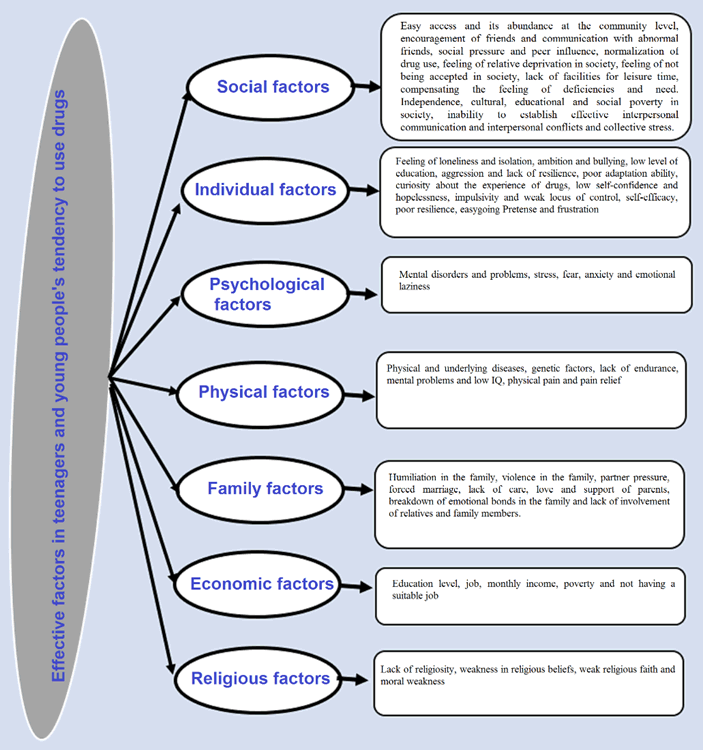
You can see the results of the Shannon entropy method in Table 4. Based on these results, the weight and rank of each factor have been identified. Factors such as encouragement of friends and communication with awkward friends, feeling of relative deprivation in society, lack of facilities for leisure time, inability to establish effective interpersonal communication, feeling of loneliness and isolation and low education level were ranked the most. Also factors such as lack of care, love and support of parents, job and monthly income, poverty and lack of suitable job, lack of religiosity, weakness in religious beliefs, weak religious faith and moral weakness had the lowest rank. Entropy shows the amount of uncertainty resulting from the content of a message. In other words, entropy in information theory is an indicator for measurement and measurement which is expressed using a probability distribution. Based on the main idea of this method, the greater the dispersion in the values of an index, the more important this index will be. Therefore, executives should pay more attention to this category of variables which have more dispersion and uncertainty. Although these variables are not very important according to experts, they have a high priority in terms of the importance of information about decisions for the future (Figure 1).
Figure 1. The final research model.
Also Friedman's test was used to evaluate the second question of the research (what is the ranking of factors affecting the tendency of adolescents and young people to addiction?). This test is suitable for within-group designs (dependent samples). The Friedman test is actually a generalization of the Wilcoxon test and is the non-parametric equivalent of the repeated measures test. We have presented the results of this test below. Table 5 is the most important table of the Friedman test. Before interpreting the other tables, we must first evaluate the results of this table and if the Friedman test is significant, then we will interpret the results of the descriptive tables and the average rank.
| Statistical indicators |
Index scores |
| Number |
30 |
| Chi square test |
18.076 |
| Degrees of freedom |
6 |
| The significance level of the test |
0.006 |
Table 5. Friedman test statistics.
Table 5 shows that this test is statistically significant. The chi-square value of the result is equal to 18.07 which is at an error level of less than 0.05 (P<0.05). The significance of Friedman's test means that the ranking of the factors is significant from the point of view of the respondents and the respondents have different rankings of the factors affecting the tendency of teenagers and young people to addiction. Also the next output shows the ranking status of the variables (factors affecting the tendency to use drugs). You can see the Mean Rank of each feature in Table 6.
| Factors |
Average factors |
Factor rank |
| Social factors |
4.53 |
2 |
| Individual factors |
4.3 |
3 |
| Psychological factors |
3.63 |
6 |
| Physical and physical factors |
3.97 |
5 |
| Family-related factors |
4.17 |
4 |
| Economic factors |
4.72 |
1 |
| Religious factors |
2.68 |
7 |
Table 6. Ratings of factors.
Comparing the average ratings shows that the highest average rating (4.72) is related to economic factors so economic factors are the most important reason for the tendency to use drugs among teenagers and young adults. The next related factor is the social factor with an average of 4.53 which ranks second. Individual factor, family factor, physical factor, psychological factor and religious factor are ranked next. The religious factor had the least importance in the tendency or lack of tendency of teenagers and young people to use drugs.
Discussion
All over the world, good progress has been made in the field of health and human development. Health services in our country are also improving. But the problem of drug addiction has reached a serious stage and drugs threaten the young generation and some people turn to drugs to solve their problems which is a worrying issue. In many countries like Iran, the problem of drug addiction has reached a very serious stage. Addiction to drugs causes many problems such as economic losses, violence, security problems, workplace accidents, etc. and the risk of contracting diseases such as HIV/AIDS also increases. Addiction to drugs is not a sudden problem and many factors affect it. This research has been done with the aim of identifying the factors affecting the tendency of teenagers and young people to use drugs according to the experts of quitting addiction. In this research, the factors affecting the tendency to addiction were discussed. These factors were classified into seven general categories, including social factors, individual factors, psychological factors, physical factors, family factors, economic factors and religious factors. Social factors include indicators such as easy access to drugs and its abundance at the community level, encouraging friends and communication with abnormal friends, social pressure and peer influence, normalization of drug use, feeling of relative deprivation in society, feeling of not being accepted in society, lack of opportunities for time Leisure, compensating the feeling of deficiencies and the need for independence, cultural, educational and social poverty in the society, inability to establish effective interpersonal communication, interpersonal conflicts and collective stress. These findings are consistent with the studies of researchers such as Mazlomi Mahmodabad, et al., Alipor Asadabadi and Namdarpor, Zare Shahabadi and Firozi, Ahadi, et al., Kadyrov and Qhadiro and Divi and Singh.
Individual factors include indicators such as feelings of loneliness and isolation, ambition and bullying, low education level, aggression and lack of resilience, poor adaptation ability, curiosity about the experience of drugs, low self-confidence and hopelessness, impulsivity and weak source of control, self-efficacy and They become weak endurance and negligence and frustration. These findings are in line with the studies of researchers such as Rastegari, et al., Zare Shahabadi and Firozi, Kadyrov and Qhadiro, Bozarth, Divi and Sing, Alipor Asadabadi and Namdarpor and Abdulahi, et al. Psychological factors include indicators such as mental disorders and problems, psycho-emotional stress, fear and anxiety and emotional laziness. These findings are in line with the studies of researchers such as Rastegari, et al., Divi and Sing, Abdulahi, et al., Alipor Asadabadi and Namdarpor and Kadyrov and Qhadiro. Physical factors include indicators such as physical and underlying diseases, genetic factors, lack of resilience, mental problems and low IQ and physical pain and pain relief. These findings are in line with the studies of researchers such as Rastegari, et al., and Alipor Asadabadi and Namdarpor. Family factors include indicators such as humiliation in the family, violence in the family, partner pressure, forced marriage, lack of care, love and support of parents, breakdown of emotional ties in the family and lack of intervention by relatives and family members. These findings are in line with the studies of researchers such as Alipor Asadabadi and Namdarpor, Rastegari, et al., Abdulahi, et al. and Kadyrov and Qhadiro. Economic factors include indicators such as education level, job and monthly income, poverty and lack of suitable job. These findings are in line with the studies of researchers such as Rastegari, et al., Mombini, et al. Belief factors also include indicators such as lack of religiosity, weakness in religious beliefs, weak religious faith and moral weakness. These findings are also in line with the studies of researchers such as Abdulahi, et al., Momeni, et al. and Divi and Sing.
Conclusion
The findings of Friedman's test show that economic factors, social factors, family factors and individual factors are most important in the tendency of teenagers and young people to use drugs. Therefore, attention should be paid to these factors and conditions should be provided for the education of people or the provision of necessary training about drugs. Employment opportunities for teenagers and young people should also be provided because poverty and unemployment cause people to become addicted. From a social point of view, governments should try to prevent the distribution of drugs. Easy access to drugs in the society is one of the reasons for the tendency of more people to drugs. Also proper acculturalization should be done to prevent people from getting addicted to drugs and favorable conditions should be provided for people's healthy leisure time.
Family plays an important role in raising healthy children so emotional ties should be promoted through educational workshops among families. Considering the economic problems in the country and violence and disharmony in families, a serious recommendation to the authorities is that the fields of economic well-being among families should be provided and individual and family skills among people should be continuously considered and the factors of tendency be identified as drugs. One of the limitations of this research is that the consequences of teenagers and young people's tendency to use drugs have not been evaluated. Also the role and contribution of each of the identified factors in the tendency of teenagers and young people to use drugs has not been determined yet. Therefore, it is suggested that in the future, research be conducted on the consequences of teenagers and young people's tendency to use drugs. It is also suggested to other researchers to verify the factors and variables identified in order to complete and validate the findings of this research and experts also set priorities. It is also suggested that researchers conduct studies with qualitative approaches such as phenomenological studies in this field.
References
- Abdullah RT, Embong R, Omar N, Yaakob R, Lateh HM, et al. The factors affecting the tedency of drug addiction among malays in malaysia. Ginatec-Gest Innov Technol. 2021;11(4):2146-2155.
[Google Scholar]
- Abdullahi AA, Abidemi OR, Ntozini A. Drug addiction and marital conflicts: Exploring the experiences of drugâ?addicted wives in Abuja, Nigeria. Confl Resolut Q. 2024;41(3):337-355.
[Crossref]
- Bozarth MA. Drug addiction as a psychobiological process. 1st Edition. CRC Press. Bristol, England. 2023:112-134.
[Google Scholar]
- Devi S, Singh S. Relapse in Drug Addiction: A Review. Indian J Health Wellbeing. 2023;14(3):405-409.
[Google Scholar]
- Gerra ML, Gerra MC, Tadonio L, Pellegrini P, Marchesi C, et al. Early parent-child interactions and substance use disorder: An attachment perspective on a biopsychosocial entanglement. Neurosci Biobehav Rev. 2021;131:560-580.
[Crossref] [Google Scholar] [PubMed]
- Kadyrov U, Kadyrov G. Drug addiction as a social-psychological problem. Sci Innov. 2024;3(B3):80-83.
[Google Scholar]
- Koijam AS, Singh KD, Nameirakpam BS, Haobam R, Rajashekar Y. Drug addiction and treatment: An epigenetic perspective. Biomed Pharmacother. 2024;170:115951.
[Crossref] [Google Scholar] [PubMed]
- Lakhanpal P, Agnihotri AK. Drug abuse an international problem: A short review with special reference to african continent. Indian J Forensic Med Toxicol. 2007;1(1):3-12.
[Google Scholar]
- Londani M, Oladimeji O. Tobacco use and behaviour among South African adolescents and young adults: Systematic review and meta-analysis. BMJ open. 2024;14(2):e079657.
[Crossref] [Google Scholar] [PubMed]
- Mahmood N, Othman S, Al-Tawil N, Al-Hadithi T. Substance use among high school students in Erbil City, Iraq: prevalence and potential contributing factors. East Mediterr Health J. 2019;25(11):806-812.
[Crossref] [Google Scholar] [PubMed]
- Oluremi Fareo D. Drug abuse among Nigerian adolescent’s strategies for counselling. J Int Soc Res. 2012;5(20).
[Google Scholar]
- Rastegari A, Haghdoost AA, Baneshi MR, Azizian M, Mehrolhassani MH. Identifying the factors affecting methamphetamine use: A scoping review. Med J Islam Repub Iran. 2023;37.
[Crossref] [Google Scholar] [PubMed]
- Strathearn L, Mertens CE, Mayes L, Rutherford H, Rajhans P, et al. Pathways relating the neurobiology of attachment to drug addiction. Front Psychiatry. 2019;10:737.
[Crossref] [Google Scholar] [PubMed]
- West R. European Monitoring Centre of Drugs and Drug Addiction (EMCDDA), insights. models of addiction. EMCDDA. Luxembourg: Publications Office of the European Union, Lisbon, Portugal. 2013.
- Whitesell M, Bachand A, Peel J, Brown M. Familial, social, and individual factors contributing to risk for adolescent substance use. J Addict. 2013;2013(1):579310.
[Crossref] [Google Scholar] [PubMed]
- Zhang M, Cui WK, Zhang YJ, Xu YH. Research on World Food Production Efficiency and Environmental Sustainability Based on Entropyâ?DEA Model. Complexity. 2021;2021(1):8730264.
[Crossref] [Google Scholar]
- Zumbrun EE, Sido JM, Nagarkatti PS, Nagarkatti M. Epigenetic regulation of immunological alterations following prenatal exposure to marijuana cannabinoids and its long term consequences in offspring. J Neuroimmune Pharmacol. 2015;10:245-54.
[Crossref] [Google Scholar] [PubMed]


 +44 1752 712024