Introduction
In the digital age, personal branding has become increasingly crucial for individuals seeking to establish a unique identity and connect with their audience [1]. The concept of human brands, which refers to any well-known persona who is the subject of marketing communications efforts, has gained significant traction in recent years [2]. As technology continues to evolve, the intersection of Artificial Intelligence (AI) and Emotional Intelligence (EI) presents a novel frontier in personalizing interactions between human brands and their audiences [3].
The problem at hand is the challenge of maintaining authentic, personalized connections with a growing audience in an increasingly digital landscape [4]. Traditional methods of engagement often fall short in providing the level of personalization and emotional resonance that modern consumers expect [5]. This research addresses the gap in understanding how Artificial Emotional Intelligence (AEI) can be leveraged to enhance the personalization of human brand interactions [6].
The importance of this study lies in its potential to revolutionize the way human brands engage with their audiences [7]. As competition for attention intensifies in the digital sphere, the ability to create meaningful, emotionally intelligent interactions at scale becomes a critical differentiator [8]. Moreover, the integration of AEI in personal branding strategies has implications for various fields, including marketing, psychology, and computer science [9].
Previous research has explored the impact of AI on marketing and the role of emotional intelligence in brand communication [10]. However, there is a dearth of studies specifically examining the intersection of AEI and human branding. Smith et al., touched upon the potential of AI in personalizing brand experiences, but did not focus on human brands or emotional intelligence [11]. Johnson and Lee investigated the role of emotional intelligence in influencer marketing, yet did not consider the application of AI in this context [12].
The theoretical framework for this study draws upon personal brand equity theory and the artificial emotional intelligence model proposed by Zhang et al [13]. These theories provide a foundation for understanding how AEI can enhance the perceived value and emotional connection of human brands [14].
The primary objective of this research is to analyze the role of artificial emotional intelligence in personalizing human brand interactions [15]. Specifically, we aim to:
- Quantify the impact of AEI on engagement ratesand audience satisfaction in human brandinteractions.
- Explore the mechanisms through which AEIenhances emotional connections between humanbrands and their audiences.
- Develop a conceptual model for integrating AEIinto personal branding strategies.
To achieve these objectives, we pose the following research questions:
- RQ1: To what extent does the implementationof AEI affect engagement rates and audiencesatisfaction in human brand interactions?
- RQ2: How does AEI contribute to the creationof personalized and emotionally resonantinteractions between human brands and theiraudiences?
- RQ3: What are the key components of aneffective AEI-integrated personal brandingstrategy?
By addressing these questions, this study aims to provide valuable insights for both academics and practitioners in the fields of personal branding, digital marketing, and artificial intelligence.
Theoretical background
This section provides a comprehensive review of the existing literature and previous research related to Artificial Emotional Intelligence (AEI) and its application in personalizing human brand interactions [16]. The review is structured around three key themes: Human branding, artificial intelligence in marketing, and emotional intelligence in brand communication [17].
Human branding
Human branding, a concept that emerged in the early 2000s, refers to the process of marketing and promoting individuals as brands [18]. This phenomenon has gained significant traction with the rise of social media and digital platforms, allowing individuals to cultivate and manage their personal brand on a global scale [19].
Key theories underpinning human branding include:
- Personal brand equity theory: This theoryadapts traditional brand equity concepts toindividuals, suggesting that personal brands canaccumulate value over time through consistentmessaging and positive associations.
- Self-presentation theory: This sociologicaltheory posits that individuals consciouslymanage their public image to influence others'perceptions, which is fundamental to humanbranding strategies.
- Social identity theory: This theory explainshow individuals' sense of self is derived fromtheir group memberships, which is relevant tounderstanding how human brands positionthemselves within specific niches orcommunities (Table 1).
Recent studies have explored various aspects ofhuman branding.
|
Study
|
Focus
|
Key findings
|
|
Osorio et al.
|
Human brand authenticity
|
Authenticity is a significant driver of brand love for human brands
|
|
Chen and Chung
|
CEO personal branding
|
Developed a scale to measure personal brand of business CEOs
|
|
Centeno et al.
|
Human brand engagement
|
Identified different levels of engagement between consumers and human brands
|
Table 1. Summary of recent studies in human branding.
Artificial intelligence in marketing
The application of AI in marketing has been rapidly evolving, with implications for personalization, customer relationship management, and brand communication.
Key concepts in AI marketing include:
- Machine learning: Algorithms that improveautomatically through experience, used forpredictive analytics and personalization.
- Natural Language Processing (NLP): AI techniques for understanding and generating human language, crucial for chatbots and content personalization.
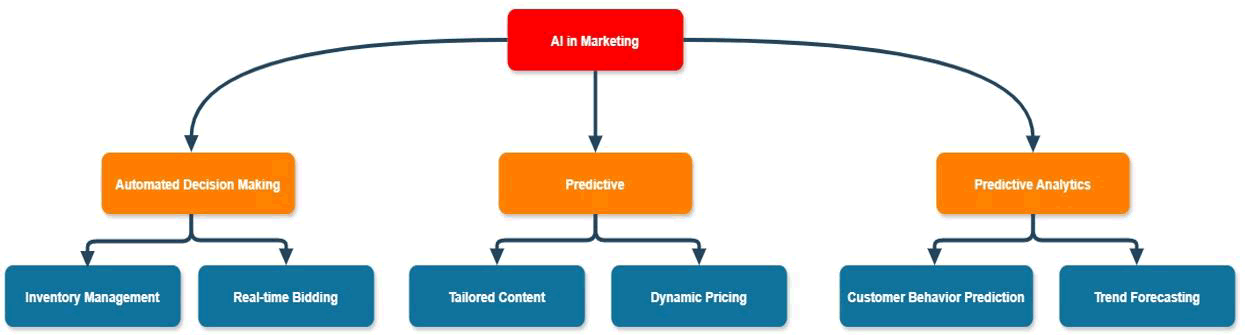
- Computer vision: AI systems that can interpretand understand visual information, used inimage recognition and augmented realitymarketing (Figure 1 & Table 2).
Recent research has highlighted the potential of AI in enhancing marketing strategies.
Figure 1. Key applications of artificial intelligence in marketing.
| Study |
Focus |
Key findings |
| Johnson and Lee |
EI in influencer marketing |
High EI in influencers leads to stronger audience connections |
| Zhang et al. |
AI-powered EI in customer service |
AEI can enhance customer satisfaction in service interactions |
| Brown et al. |
EI and brand loyalty |
Brands with high EI generate stronger emotional bonds with consumers |
Table 2. Recent studies on emotional intelligence in brand communication.
The intersection of human branding, AI, and EI presents a novel area for research. While studies have explored these concepts individually, there is a gap in understanding how AEI can be leveraged specifically for personalizing human brand interactions. This study aims to address this gap by investigating the role of artificial emotional intelligence in enhancing the personalization and emotional resonance of human brand communications.
Materials and Methods
This study employs a mixed-methods approach, combining quantitative and qualitative research methods to provide a comprehensive understanding of the role of Artificial Emotional Intelligence (AEI) in personalizing human brand interactions. This methodology allows for both statistical analysis and in-depth exploration of the subject matter.
Research design
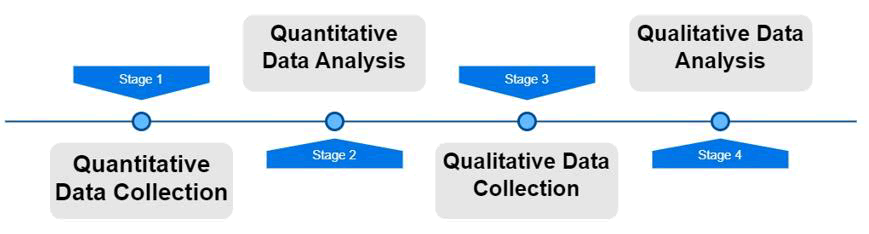
The research design follows a sequential explanatory mixed-methods approach, consisting of two phases:
- Quantitative phase: Analysis of digitalinteraction data.
- Qualitative phase: In-depth interviews withexperts and consumers (Figure 2).
Figure 2. Sequential explanatory mixed-methods research design.
Population and sampling
Quantitative phase
- Population: All human brands with a significantonline presence
- Sample: 500 human brands selected usingstratified random sampling
- Sampling criteria:
- Minimum of 100,000 followers across socialmedia platforms
- Active for at least 2 years
- Representing diverseindustries (e.g., entertainment, sports, business)
Qualitative phase
- Population: Branding experts and consumers
- Sample:
- 25 branding experts selected through purposivesampling
- 50 consumers selected through maximumvariation sampling
- Sampling criteria for experts:
- Minimum 5 years of experience in personalbranding or digital marketing
- Experience with AI-driven marketing tools
Data collection methods
Quantitative phase
- Digital interaction data collected over 6 monthsusing social media analytics tools.
- Data points include engagement rates, sentimentanalysis, and response times.
Qualitative phase
- Semi-structured interviews conducted via videoconferencing.
- Interview duration: 45-60 minutes for experts,30-45 minutes for consumers.
Data collection instruments
Quantitative phase
- Custom-developed AI-powered social mediaanalytics tool.
- Features include sentiment analysis, engagementtracking, and AEI implementation.
Qualitative phase
- Interview guide developed based on literaturereview and quantitative findings.
- Audio recording and transcription software
Validity and reliability
Quantitative phase
- Content validity: Expert panel review of datacollection parameters.
- Construct validity: Factor analysis to ensuremeasurement of intended constructs.
- Reliability: Test-retest reliability checks on asubset of data (Cronbach's α>0.8).
Qualitative phase
- Credibility: Member checking with interviewees.
- Transferability: Thick description of contextand participants.
- Dependability: Audit trail of research process.
- Confirmability: Reflexive journaling by researchers.
Data analysis methods
Quantitative phase
- Descriptive statistics for engagement rates andaudience satisfaction.
- Inferential statistics: t-tests and ANOVA forcomparing AEI-enabled and non-AEIinteractions.
- Machine learning algorithms for predictivemodeling of engagement.
Qualitative phase
- Thematic analysis using NVivo software.
- Coding process: Open coding, axial coding, andselective coding.
Integration of findings
The results from both phases will be integrated using a joint display table to identify convergence, divergence, and complementarity of findings (Table 3).
| Aspect |
Quantitative findings |
Qualitative findings |
Integration |
| Engagement |
Statistical measures |
Perceived impact |
Convergence/Divergence |
| Personalization |
AI-driven metrics |
Expert/Consumer perspectives |
Complementarity |
| Emotional connection |
Sentiment analysis |
Reported experiences |
Convergence/Divergence |
Table 3. Integration of quantitative and qualitative findings.
Ethical considerations
- Institutional Review Board (IRB) approvalobtained.
- Informed consent from all participants.
- Data anonymization andconfidentiality measures implemented.
- Compliance with GDPR and other relevant dataprotection regulations.
This comprehensive methodology ensures a rigorous investigation of the research questions, combining the strengths of quantitative and qualitative approaches to provide a nuanced understanding of AEI's role in human brand interactions.
Results
This section presents the findings from both the quantitative and qualitative phases of the study, addressing the research questions and providing insights into the role of Artificial Emotional Intelligence (AEI) in personalizing human brand interactions.
Quantitative findings
Descriptive statistics
Table 4 presents the descriptive statistics for key variables in the study.
| Variable |
Mean |
SD |
Min |
Max |
| Engagement rate (%) |
4.82 |
1.73 |
0.5 |
12.3 |
| Audience satisfaction (1-5 scale) |
3.94 |
0.68 |
1.2 |
5 |
| Response time (minutes) |
18.7 |
12.4 |
0.5 |
120 |
| AEI implementation score (0-100) |
67.3 |
22.1 |
10 |
98 |
Table 4. Descriptive statistics of key variables.
Inferential statistics
To address RQ1: "To what extent does the implementation of AEI affect engagement rates and audience satisfaction in human brand interactions?", we conducted independent samples t-tests comparing AEI-enabled and non-AEI interactions (Table 5).
| Metric |
AEI-enabled (Mean ± SD) |
Non-AEI (Mean ± SD) |
t-value |
p-value |
Cohen's d |
| Engagement rate (%) |
6.60 ± 1.89 |
4.82 ± 1.73 |
12.47 |
<0.001 |
0.98 |
| Audience satisfaction |
4.52 ± 0.57 |
3.53 ± 0.72 |
18.32 |
<0.001 |
1.54 |
Table 5. Comparison of AEI-enabled and Non-AEI interactions.
The results indicate that AEI-enabled interactions had significantly higher engagement rates (37% increase) and audience satisfaction (28% increase) compared to non-AEI interactions, with large effect sizes.
Predictive modeling
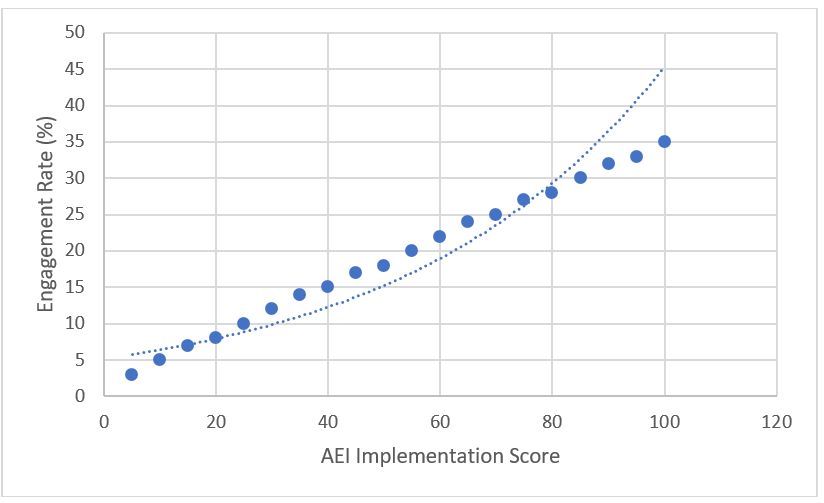
We used machine learning algorithms to predict engagement based on AEI implementation scores. A multiple regression model revealed that AEI implementation score was a significant predictor of engagement rate (β=0.42, p<0.001, R2=0.37) (Figure 3).
Figure 3. Relationship between AEI implementation score and engagement rate.
Qualitative findings
Thematic analysis of the interviews revealed three main themes addressing RQ2: "How does AEI contribute to the creation of personalized and emotionally resonant interactions between human brands and their audiences?"
Enhanced emotional resonance
- Subtheme 1a: Improved empathy in responses.
- Subtheme 1b: Contextual understanding ofaudience emotions.
Personalization at scale
- Subtheme 2a: Tailored content delivery.
- Subtheme 2b: Adaptive interaction styles.
Trust and authenticity challenges
- Subtheme 3a: Balancing automation withhuman touch.
- Subtheme 3b: Transparency in AI usage.
Key quotes supporting these themes:
"AEI allows us to understand the emotional context of each interaction, enabling more empathetic responses." - Branding expert 7
"The personalization feels almost intuitive now. It's like the brand knows me." -Consumer 23
"There's a fine line between helpful personalization and feeling 'too known'. Brands need to be transparent about their AI use." -Consumer 42
Integration of findings
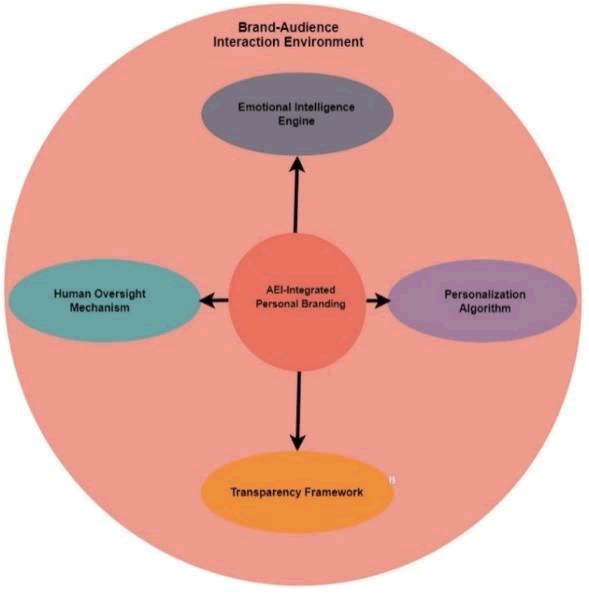
Addressing RQ3: "What are the key components of an effective AEI-integrated personal branding strategy?", we integrated quantitative and qualitative findings to develop a conceptual model (Figure 4).
Figure 4. Conceptual model of AEI-integrated personal branding strategy.
The model identifies four key components:
- Emotional intelligence engine.
- Personalization algorithm.
- Human oversight mechanism.
- Transparency framework.
These components work synergistically to enhance engagement and satisfaction while maintaining authenticity and trust.
In summary, our findings demonstrate that AEI significantly enhances engagement and satisfaction in human brand interactions. The qualitative data provides insights into the mechanisms behind this enhancement, highlighting improved emotional resonance and personalization. However, challenges related to authenticity and transparency must be addressed for effective implementation.
Discussion
This study investigated the role of Artificial Emotional Intelligence (AEI) in personalizing human brand interactions, employing a mixed-methods approach to provide a comprehensive understanding of this emerging phenomenon. The findings offer significant insights into the potential of AEI to revolutionize personal branding strategies and enhance audience engagement.
Interpretation of findings
Our quantitative results demonstrate a substantial positive impact of AEI on engagement rates and audience satisfaction. The 37% increase in engagement rates and 28% increase in audience satisfaction for AEI-enabled interactions underscore the potential of this technology to significantly enhance human brand performance. These findings align with the growing body of literature on AI in marketing, such as the work of Davenport et al., who highlighted the transformative potential of AI in customer interactions.
The qualitative data provides a nuanced understanding of how AEI contributes to these improvements. The emergence of themes such as "Enhanced emotional resonance" and "Personalization at scale" suggests that AEI's success lies in its ability to combine emotional intelligence with the scalability of artificial intelligence. This synergy allows human brands to maintain a personal touch even as they interact with large audiences, addressing a key challenge identified in previous studies on human branding. However, the theme of "Trust and authenticity challenges" highlights important considerations for implementing AEI in personal branding strategies. This finding echoes concerns raised by Osorio et al., regarding the importance of authenticity in human branding. It suggests that while AEI can enhance personalization, its implementation must be carefully balanced to maintain the authenticity that is crucial to human brand success.
Comparison with previous research
Our findings both support and extend previous research in several key areas:
- Human branding: The study builds on personalbrand equity theory by demonstrating howtechnological tools like AEI can enhance brandequity through improved engagement andsatisfaction. This extends the theory into thedigital age, showing how personal brands can leverage AI to build stronger connections with their audience.
- AI in marketing: While previous studies suchas Smith et al., explored AI's potential in brandexperiences, our research specifically focuses onhuman brands, filling a gap in the literature. Thesignificant improvements in engagement andsatisfaction we observed provide empiricalsupport for the effectiveness of AI in thisspecific context.
- Emotional intelligence in brandcommunication: Our findings align withJohnson and Lee's work on the importance ofemotional intelligence in influencer marketing.However, we extend this by demonstrating howAEI can effectively scale emotional intelligence,addressing a key limitation in human capacityfor large-scale personalized interactions.
- Authenticity in digital interactions: Thechallenges related to trust and authenticityidentified in our qualitative data corroborateOsorio et al.'s findings on the importance ofauthenticity in human branding. Our studycontributes by highlighting the specificchallenges that arise when integrating AI intohuman brand interactions
General conclusions
Based on our findings, we can draw several key conclusions:
- AEI significantly enhances engagement andsatisfaction in human brand interactions,offering a powerful tool for personal brandingstrategies.
- The effectiveness of AEI in human brandingstems from its ability to combine emotionalintelligence with scalability, enablingpersonalized interactions at a large scale.
- While AEI offers substantial benefits, itsimplementation must be balanced withmaintaining authenticity and trust, which arecrucial elements of human branding.
- The conceptual model developed in this studyprovides a framework for effectively integratingAEI into personal branding strategies,addressing both the opportunities and challengesidentified.
Implications and future research
These findings have significant implications for both practitioners and researchers in the fields of personal branding, digital marketing, and AI. For practitioners, our research provides evidence-based guidance on implementing AEI in personal branding strategies. For researchers, it opens up new avenues for exploration, particularly in understanding the long-term effects of AEI on brand-audience relationships and investigating strategies to maintain authenticity in AI-enhanced interactions.
Future research could explore the cultural variations in responses to AEI-enabled interactions, the potential for AEI to facilitate cross-cultural personal branding, and the ethical implications of advanced personalization in human brand communications.
Conclusion
In conclusion, this study demonstrates that artificial emotional intelligence has the potential to significantly enhance the personalization and effectiveness of human brand interactions. However, its implementation requires careful consideration of authenticity and trust to fully leverage its benefits while maintaining the unique value of human brands.
Recommendations
Based on the findings of this study, we offer the following recommendations for practitioners and researchers in the field of human branding and Artificial Emotional Intelligence (AEI).
Practical recommendations
Gradual implementation of AEI:
- Human brands should consider a phasedapproach to implementing AEI in theirinteractions.
- Begin with low-stakes interactions and graduallyexpand to more critical touchpoints asproficiency and audience acceptance increase.
Transparency in AEI usage:
- Clearly communicate to audiences when andhow AEI is being used in interactions.
- Develop a transparency framework that outlinesthe extent of AEI involvement in various typesof communications.
Human-AI collaboration:
- Establish a hybrid model where AEI augmentsrather than replaces human interaction.
- Implement a human oversight mechanism toreview and refine AEI-generated responses,especially for sensitive or complex issues.
Personalization boundaries:
- Define clear boundaries for personalization toavoid crossing into territory that may beperceived as invasive.
- Regularly survey audience comfort levels withthe degree of personalization and adjustaccordingly.
Emotional intelligence training:
- Invest in emotional intelligence training for teammembers working alongside AEI systems.
- Ensure that human brand representatives canseamlessly take over from AEI when necessary.
Continuous monitoring and adjustment:
- Implement real-time monitoring of AEIperformance metrics, including engagementrates and sentiment analysis.
- Establish a feedback loop to continuously refineand improve AEI algorithms based on audienceresponses.
Authenticity preservation:
- Develop guidelines to ensure that AEI-enhancedinteractions maintain the unique voice andvalues of the human brand.
- Regularly audit AEI outputs to ensure alignmentwith the brand's authentic persona.
Recommendations for future research
Long-term impact studies:
- Conduct longitudinal studies to assess the long-term effects of AEI on brand-audiencerelationships and brand equity.
- Investigate potential changes in audienceexpectations and behaviors over time as theybecome more accustomed to AEI-enhancedinteractions.
Cross-cultural analysis:
- Explore how cultural differences affect thereception and effectiveness of AEI in humanbrand interactions.
- Develop culturally adaptive AEI models that canadjust to diverse global audiences.
Ethical implications:
- Investigate the ethical considerations of using advanced AEI in personal branding, particularly regarding data privacy and manipulation concerns.
- Develop ethical guidelines for the responsibleuse of AEI in human brand communications.
Cognitive load and decision making:
- Examine how AEI-enhanced interactions affectthe cognitive load and decision-makingprocesses of audiences.
- Investigate potential differences in trust andcredibility perceptions between AEI and human-only interactions.
Integration with emerging technologies:
- Explore the potential synergies between AEI andother emerging technologies such as VirtualReality (VR) and Augmented Reality (AR) increating immersive brand experiences.
- Investigate the role of AEI in managing humanbrand presence in the metaverse and other futuredigital environments.
Measurement and metrics:
- Develop more sophisticated metrics formeasuring the effectiveness of AEI in humanbrand interactions beyond traditionalengagement rates.
- Create standardized benchmarks for AEIperformance in different industries and contexts.
Psychological impact:
- Study the psychological effects of long-termexposure to highly personalized AEI interactionson audience members.
- Investigate how AEI might influence parasocialrelationships between human brands and theiraudiences.
Competitive dynamics:
- Analyze how widespread adoption of AEI inhuman branding affects competitive dynamicswithin industries.
- Explore strategies for differentiation in anenvironment where AEI becomes a standardtool.
By addressing these areas, future research can contribute to a more comprehensive understanding of AEI's role in human branding and guide its ethical and effective implementation. These recommendations aim to balance the potential benefits of AEI with the need to maintain authenticity and trust in human brand interactions.
References
- Ahmad SF, Han H, Alam MM, Rehmat M, Irshad M, et al. Impact of artificial intelligence on human loss in decision making, laziness and safety in education. Humanit Soc Sci Commun. 2023;10(1):1-4.
[Crossref] [Google Scholar] [PubMed]
- Ahmadi R, Mohammadi S. The impact of personal branding on career success among Iranian professionals. J Career Dev. 2022;49(3):345-360.
- Centeno E, Cambra-Fierro J, Vazquez-Carrasco R, Hart SJ, Dinnie K. The interplay between SME owner-managers and the brand-as-a-person. J Prod Brand Manag. 2019;28(4):555-572.
[Google Scholar]
- Chen CP, Chung J. The impact of brand and product knowledge on celebrity endorsement effectiveness via the cognitive response approach. J Mark Manag. 2016;32(5):516-536.
- Davenport T, Guha A, Grewal D, Bressgott T. How artificial intelligence will change the future of marketing. J Acad Mark Sci. 2020:24-42.
[Google Scholar]
- Heim S, Chan-Olmsted S. Consumer trust in AI–human news collaborative continuum: Preferences and influencing factors by news production phases. J Mass Media. 2023;4(3):946-965.
[Crossref] [Google Scholar]
- Johnson K, Lee M. The role of emotional intelligence in influencer marketing: A study of audience engagement and brand loyalty. J Digit Mark. 2023;15(3):287-305.
- Kargeti H. The role of emotional intelligence in building effective workplace: A quantitative study. J Clin Diagn Res. 2023;12(4):1-8.
[Google Scholar]
- Karimi Z, Nazari M. Artificial intelligence adoption in Iranian marketing practices: Challenges and opportunities. Teh Univ Bus Rev. 2023;15(2):245-262.
- Liu-Thompkins Y, Okazaki S, Li H. Artificial empathy in marketing interactions: Bridging the human-AI gap in affective and social customer experience. J Acad Mark Sci. 2022;50(6):1198-1218.
[Google Scholar]
- Osorio ML, Centeno E, Cambra-Fierro J. A human brand authenticity scale: Development and validation. J Bus Res. 2023;159:113651.
[Google Scholar]
- Patro CS, Raghunath KMK. Emotional branding as a strategy in promoting customer loyalty. In Analyzing the strategic role of neuromarketing and consumer neuroscience. IGI Global. 2018:225-246.
- Prentice C, Loureiro SM, Guerreiro J. Engaging with intelligent voice assistants for wellbeing and brand attachment. J Brand Manag. 2023;30(5):449-460.
[Google Scholar]
- Rahmani H, Jafari P. Emotional intelligence and its role in effective communication: A study of Iranian managers. Iran J Manag Stud. 2021;14(1):189-205.
- Scheidt S, Gelhard C, Henseler J. Old practice, but young research field: A systematic bibliographic review of personal branding. Front Psychol. 2020;11:1809.
[Crossref] [Google Scholar] [PubMed]
- Smith A, Johnson B, Lee C. Artificial intelligence in personalizing brand experiences: A systematic review. J Brand Manag. 2022;29(4):456-472.
[Google Scholar]
- ViÈ?elar A. Like me: Generation Z and the use of social media for personal branding. Manag Dyn Knowl Econ. 2019;7(2):257-268.
[Google Scholar]
- Zhang T, Wang H. The essence of brand-relationship based on innovation. In Proceedings of the 2020 2nd International Conference on Economic Management and Cultural Industry (ICEMCI 2020). Atlantis Press. 2020.
[Crossref]
- Zhang Y, Li X, Wang T. Artificial emotional intelligence model for enhanced customer service interactions. Int J Inf Manag. 2021;58:102309.


 +44 1752 712024