 +44 1752 712024

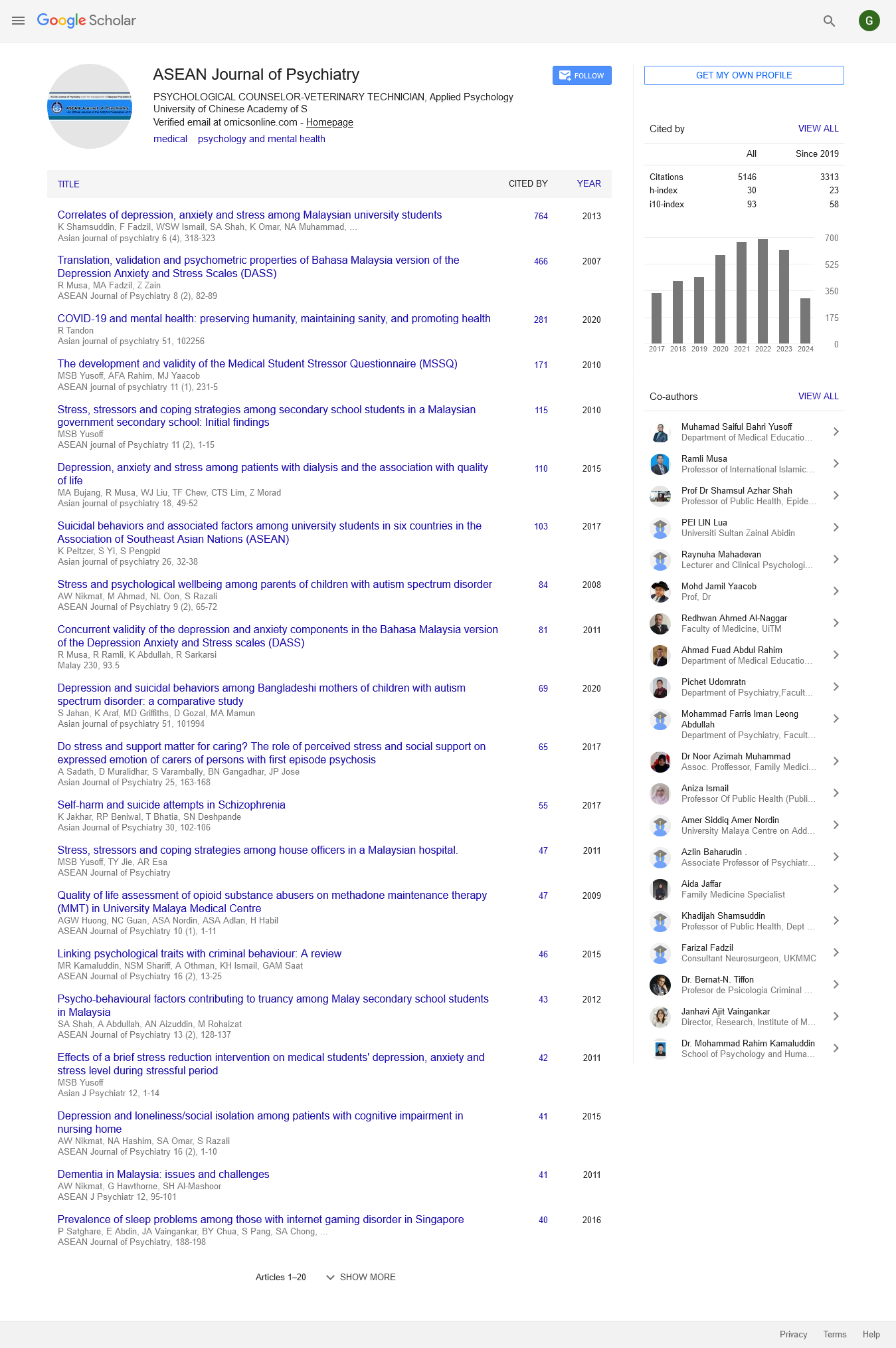
Google Scholar citation report
Citations : 5373
ASEAN Journal of Psychiatry received 5373 citations as per google scholar report
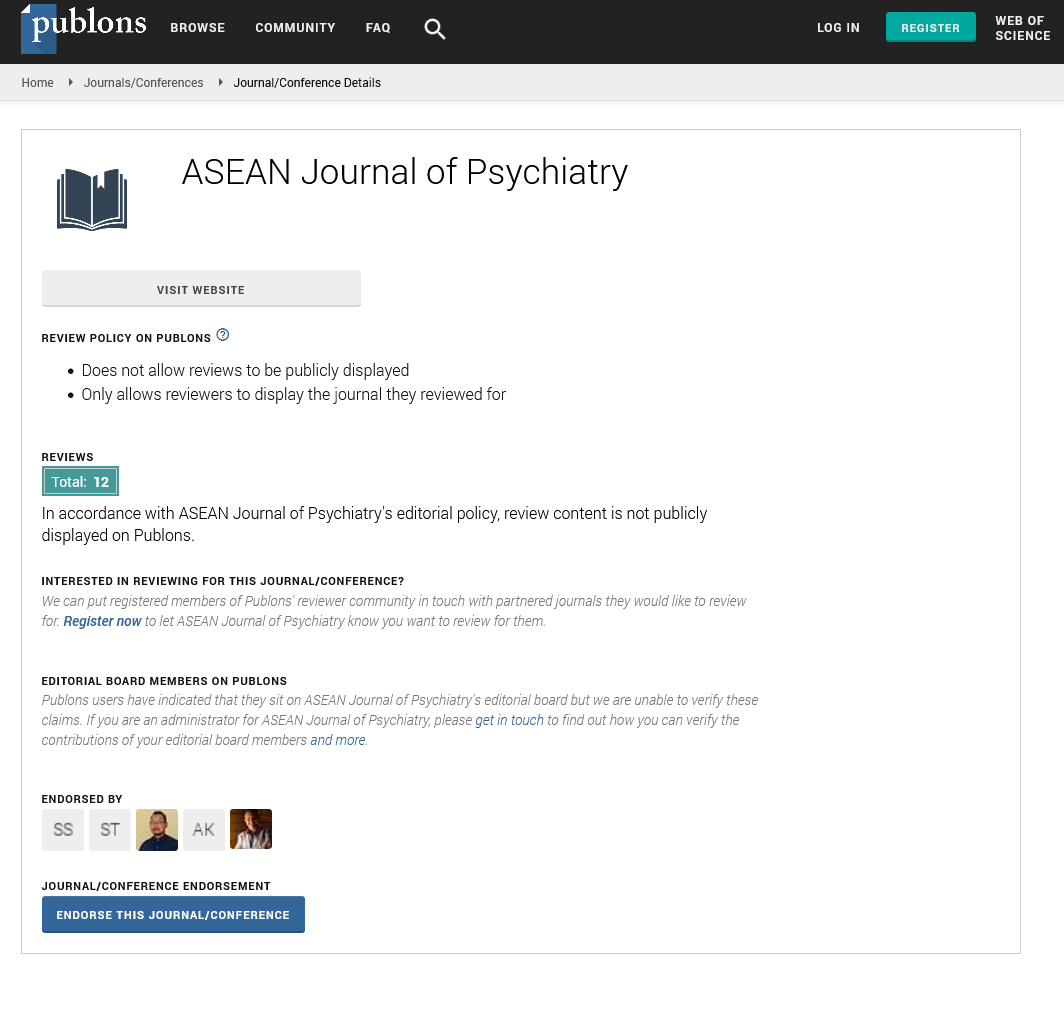
ASEAN Journal of Psychiatry peer review process verified at publons
| Journal Name | ASEAN Journal of Psychiatry (MyCite Report) | ||||
|---|---|---|---|---|---|
| Total Publications | 456 | ||||
| Total Citations | 5688 | ||||
| Total Non-self Citations | 12 | ||||
| Yearly Impact Factor | 0.93 | ||||
| 5-Year Impact Factor | 1.44 | ||||
| Immediacy Index | 0.1 | ||||
| Cited Half-life | 2.7 | ||||
| H-index | 30 | ||||
| Quartile |
|
- Anxiety Disorders
- Behavioural Science
- Biological Psychiatry
- Child and Adolescent Psychiatry
- Community Psychiatry
- Dementia
- Community Psychiatry
- Suicidal Behavior
- Social Psychiatry
- Psychiatry
- Psychiatry Diseases
- Psycho Trauma
- Posttraumatic Stress
- Psychiatric Symptoms
- Psychiatric Treatment
- Neurocognative Disorders (NCDs)
- Depression
- Mental Illness
- Neurological disorder
- Neurology
- Alzheimer's disease
- Parkinson's disease
Abstract
UNVEILING STUDENTS? ATTITUDE TOWARD COVID-19 MEASURES
Author(s): Marvien M. Barrios#This study aimed to determine the students’ attitude toward COVID-19 measure. Specifically, it sought to ascertain the demographics attributes, vaccination status and willingness of the respondents to be immunized. Moreover, the study evaluates the students’ belief about COVID-19 vaccination as a measure in terms of susceptibility, severity, benefits, and barriers to avail the vaccine and determine if it influences their willingness to be immunized. The study was conducted in one of the State College in North Cotabato Philippines and included 462 students from various year level. The researcher used descriptive statistics to explicate the data utilizing Binary Logistic Regression (BLR) for data treatment. Essential research findings revealed that 387 of the respondents were young adults, majority are female, and mostly freshmen. A sizeable portion of 85% were not yet vaccinated although 65% out of the total population are willing to be immunized. Major findings highlighted the respondent’s belief of their vulnerability to COVID-19. They also recognize its severe effects to humans. Moreover, respondents show confidence that the COVID-19 vaccine can prevent contracting disease. They also acknowledge that it is a good measure to safeguard others while reducing their fear on COVID-19 related sickness. Findings further revealed that their belief in susceptibility and severity significantly influences the student’s willingness to be vaccinated by 2.60%. This means that individuals who perceive themselves as more susceptible and at higher risk to contract COVID-19 are more likely to express their willingness to be immunized. This finding highlights the significance of understanding and addressing individuals' risk perceptions and beliefs in shaping their attitudes toward COVID-19 vaccination. Hence, the government may consider intensifying information dissemination campaign focusing more on the community’s susceptibility and severity from the virus, potentially leading to more effective public health policies. ASEAN Journal of Psychiatry, Vol. 27 (1) January, 2026; 1-7.