 +44 1752 712024

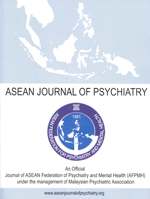
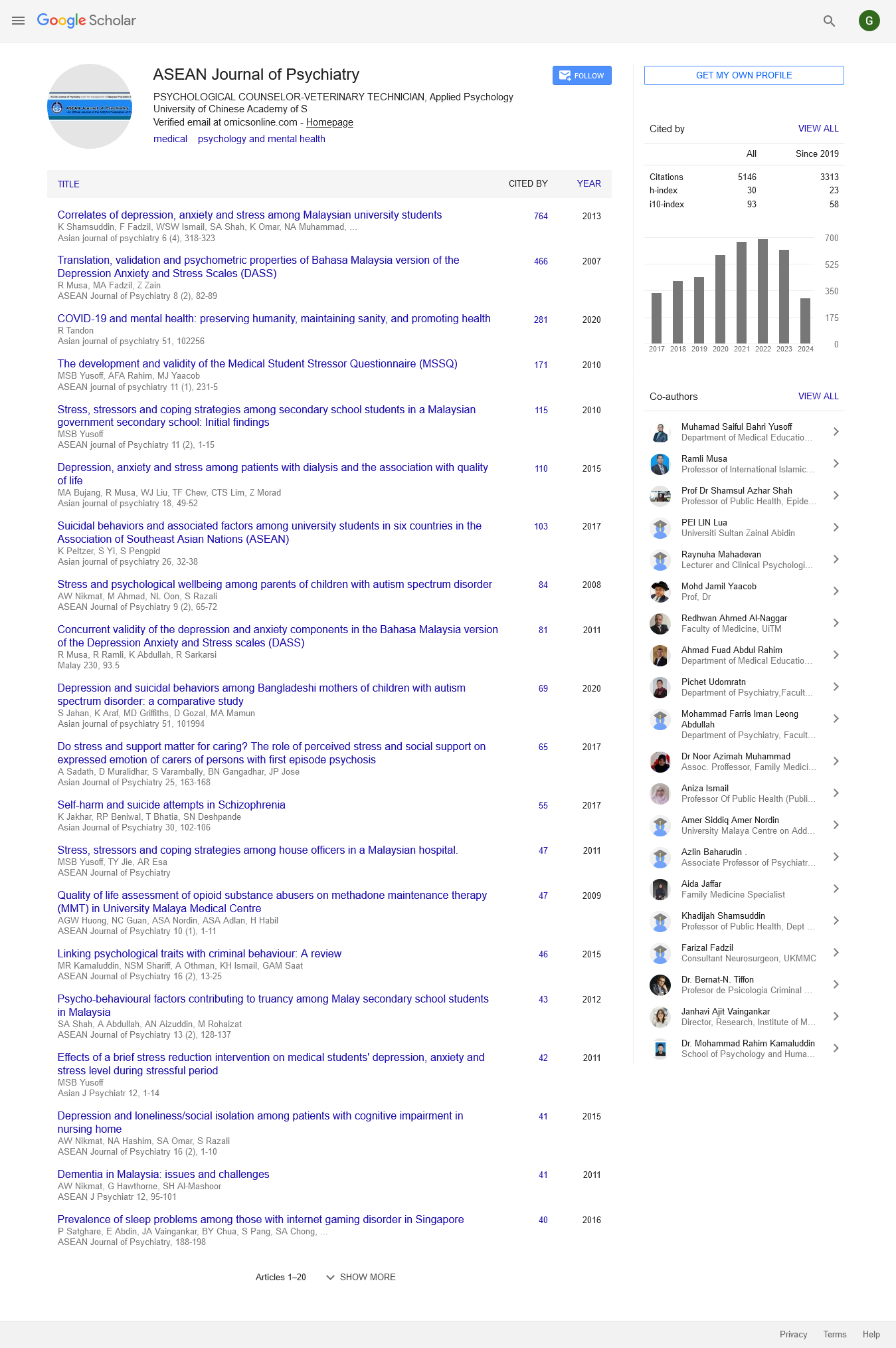
Google Scholar citation report
Citations : 5373
ASEAN Journal of Psychiatry received 5373 citations as per google scholar report
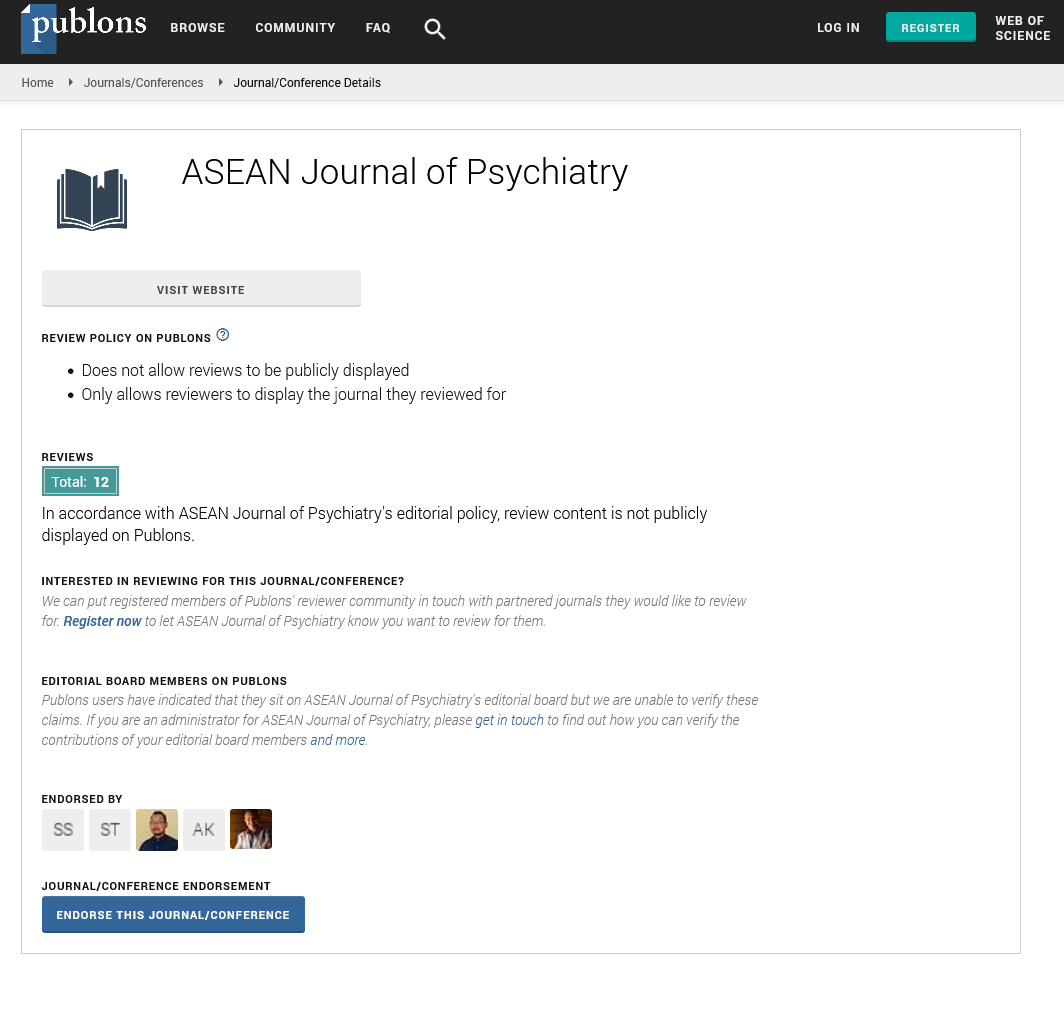
ASEAN Journal of Psychiatry peer review process verified at publons
| Journal Name | ASEAN Journal of Psychiatry (MyCite Report) | ||||
|---|---|---|---|---|---|
| Total Publications | 456 | ||||
| Total Citations | 5688 | ||||
| Total Non-self Citations | 12 | ||||
| Yearly Impact Factor | 0.93 | ||||
| 5-Year Impact Factor | 1.44 | ||||
| Immediacy Index | 0.1 | ||||
| Cited Half-life | 2.7 | ||||
| H-index | 30 | ||||
| Quartile |
|
- Anxiety Disorders
- Behavioural Science
- Biological Psychiatry
- Child and Adolescent Psychiatry
- Community Psychiatry
- Dementia
- Community Psychiatry
- Suicidal Behavior
- Social Psychiatry
- Psychiatry
- Psychiatry Diseases
- Psycho Trauma
- Posttraumatic Stress
- Psychiatric Symptoms
- Psychiatric Treatment
- Neurocognative Disorders (NCDs)
- Depression
- Mental Illness
- Neurological disorder
- Neurology
- Alzheimer's disease
- Parkinson's disease
Abstract
THE RELATIONSHIP BETWEEN DEPRESSION, ANXIETY, STRESS, AND ACADEMIC PERFORMANCE AMONG UNIVERSITY STUDENTS
Author(s): Mutaz Maawia Osman#Background: University students face escalating mental health challenges, yet the collective impact of depression, anxiety, and stress on academic performance remains underexplored. This study addresses this gap by investigating their interrelationships and academic performance.
Methods: A cross-sectional, correlational design was employed with 85 university students (77.6% female, mean age=20.4 years). Validated measures (DASS-21 for depression/anxiety/stress; academic performance scale) were administered. Pearson’s correlation analyses tested associations between these psychological distress variables and academic performance.
Results: Significant negative correlations emerged between academic performance and depression (*r*=−0.50, *p*<0.01), anxiety (*r*=−0.47, *p*<0.01), and stress (*r*=−0.47, *p*<0.01). Strong positive intercorrelations among depression, anxiety (*r*=0.74), and stress (*r*=0.84) highlighted their co-occurrence.
Implications: Findings underscore the need for integrated mental health interventions (e.g., mindfulness programs, policy reforms) to mitigate students’ anxiety, stress, depression and enhance academic performance. Future research should adopt longitudinal designs to explore causal pathways. ASEAN Journal of Psychiatry, Vol. 27 (02) May, 2026; 1-8.