 +44 1752 712024

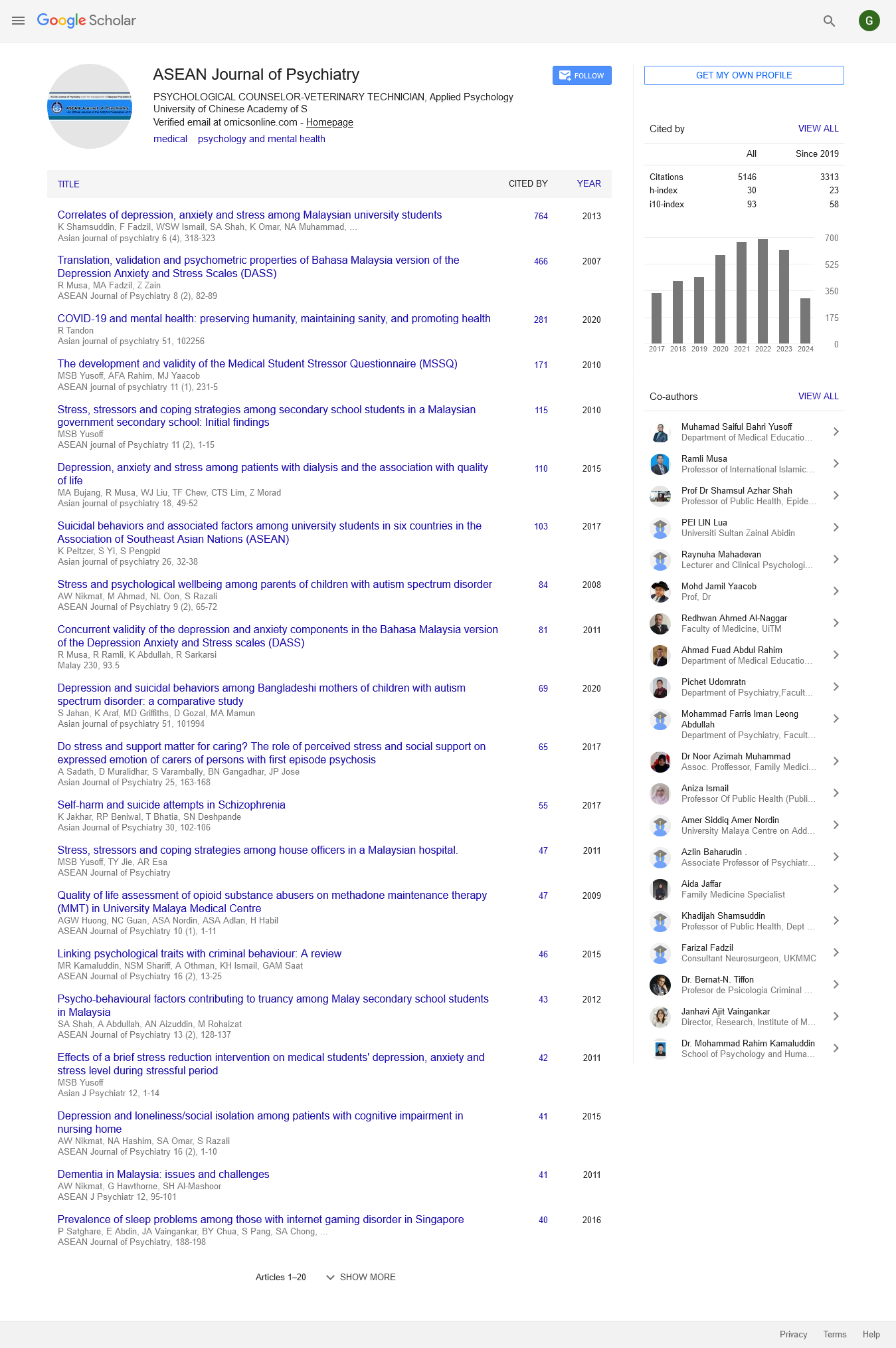
Google Scholar citation report
Citations : 5373
ASEAN Journal of Psychiatry received 5373 citations as per google scholar report
ASEAN Journal of Psychiatry peer review process verified at publons
| Journal Name | ASEAN Journal of Psychiatry (MyCite Report) | ||||
|---|---|---|---|---|---|
| Total Publications | 456 | ||||
| Total Citations | 5688 | ||||
| Total Non-self Citations | 12 | ||||
| Yearly Impact Factor | 0.93 | ||||
| 5-Year Impact Factor | 1.44 | ||||
| Immediacy Index | 0.1 | ||||
| Cited Half-life | 2.7 | ||||
| H-index | 30 | ||||
| Quartile |
|
- Anxiety Disorders
- Behavioural Science
- Biological Psychiatry
- Child and Adolescent Psychiatry
- Community Psychiatry
- Dementia
- Community Psychiatry
- Suicidal Behavior
- Social Psychiatry
- Psychiatry
- Psychiatry Diseases
- Psycho Trauma
- Posttraumatic Stress
- Psychiatric Symptoms
- Psychiatric Treatment
- Neurocognative Disorders (NCDs)
- Depression
- Mental Illness
- Neurological disorder
- Neurology
- Alzheimer's disease
- Parkinson's disease
Abstract
Severe Kwashiorkor and Scurvy Secondary to Avoidant/Restrictive Food Intake Disorder (ARFID) in a Child with Previously Undiagnosed Autism Spectrum Disorder: A Case Report
Author(s): Anunda Pira, Jittima MonwiratkulBackground: Avoidant/Restrictive Food Intake Disorder (ARFID) is highly prevalent in children with Autism Spectrum Disorder (ASD). While selective eating is common, Severe Acute Malnutrition (SAM) manifesting as Kwashiorkor in non-famine settings is rare. This report highlights a life-threatening presentation of nutritional deficiency driven solely by behavioral restriction. Case Presentation: A 6-year-old Thai boy presented with generalized edema, desquamating rash for 2 month. History revealed a 1-year duration of extreme food selectivity, consuming only specific brands of rice crackers and refusal of solids, coinciding with developmental regression. Physical examination revealed anasarca, “flaky paint” dermatosis, and perifollicular hemorrhages. Anthropometry showed severe wasting masked by edema. Laboratory investigations confirmed hypoalbuminemia (2.4 g/dL), anemia, and undetectable Vitamin C levels (<0.10 mg/L). Developmental assessment revealed deficits in social communication and restrictive interests, confirming a diagnosis of ASD.