 +44 1752 712024

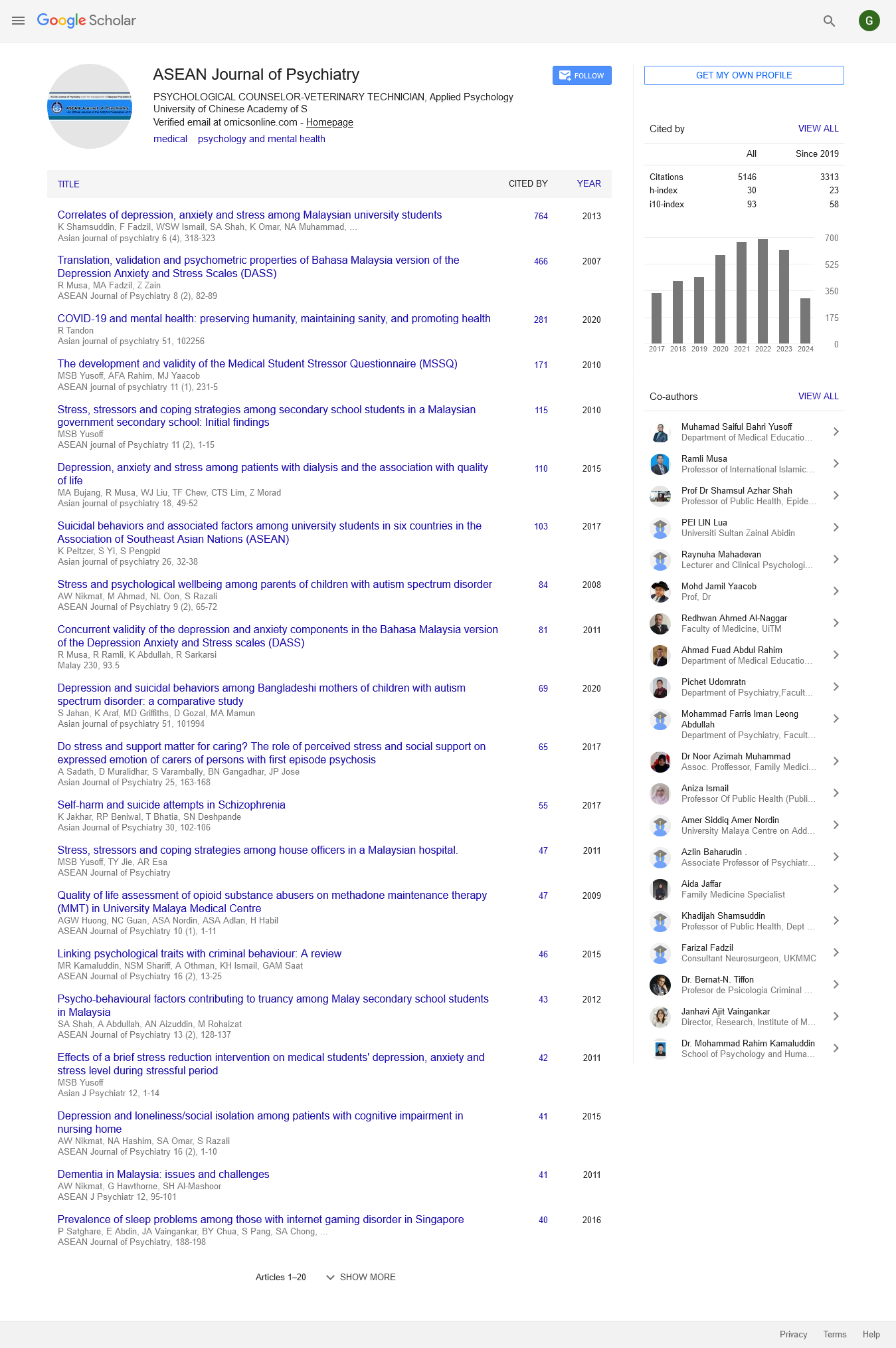
Google Scholar citation report
Citations : 5373
ASEAN Journal of Psychiatry received 5373 citations as per google scholar report
ASEAN Journal of Psychiatry peer review process verified at publons
| Journal Name | ASEAN Journal of Psychiatry (MyCite Report) | ||||
|---|---|---|---|---|---|
| Total Publications | 456 | ||||
| Total Citations | 5688 | ||||
| Total Non-self Citations | 12 | ||||
| Yearly Impact Factor | 0.93 | ||||
| 5-Year Impact Factor | 1.44 | ||||
| Immediacy Index | 0.1 | ||||
| Cited Half-life | 2.7 | ||||
| H-index | 30 | ||||
| Quartile |
|
- Anxiety Disorders
- Behavioural Science
- Biological Psychiatry
- Child and Adolescent Psychiatry
- Community Psychiatry
- Dementia
- Community Psychiatry
- Suicidal Behavior
- Social Psychiatry
- Psychiatry
- Psychiatry Diseases
- Psycho Trauma
- Posttraumatic Stress
- Psychiatric Symptoms
- Psychiatric Treatment
- Neurocognative Disorders (NCDs)
- Depression
- Mental Illness
- Neurological disorder
- Neurology
- Alzheimer's disease
- Parkinson's disease
Abstract
MEASUREMENT OF COPING STRATEGIES OF PERSON WITH DISABILITIES (PwD) AND ITS ASSOCIATION WITH DEPRESSION AND ANXIETY
Author(s): Noorhafni Syamsir*#, Aida Syarinaz Ahmad Adlan**, Norhamizan Hamzah*Introduction: Coping is defined as response aimed at diminishing physical, emotional and psychological burden that is linked to stressful life events. Adult PwD is reportedly prone to depression and anxiety, and health-related risk behaviours. This study aims to provide sociodemographic profiles of adults PwD in local setting, and prevalence of depression and anxiety in them. Also to examine type of coping strategies being used specific to each PwD group, and how the usage is associated with development of depression and anxiety.
Methods: A cross-sectional study from October 2023-October 2024. Study population involves patient with established diagnosis (>1 year) of stroke, Acquired Brain Injury (ABI) and Spinal Cord Injury (SCI) patients who receives outpatient treatment in our centre. Questionnaires involved are Brief-Coping Orientation to Problems Experience (COPE), PHQ-9 and GAD-7.
Results: A total of 137 patients included, with 42 ABI patients, 48 SCI patients and 47 stroke patients. The mean age of patients was 47.64 years old. Majority of patients were married (57.7%), Malay (51.8%), male (65.0%) who studied up to secondary level (44.5%) and were professionals (18.2%). The ABI group observed to have the lowest level of anxiety and depression, and highest were among the stroke patients. Among ABI patients, significant coping strategies related to anxiety and depression include emotion coping, self-blaming and avoidance coping. In spine patients, increase self-blame and avoidance coping significantly increases the GAD-7 scores, while increase in self-distraction decreases it. As for depression, the significant factors associated included venting, self-blame, substance use and behavioural disengagement. In stroke population, increase in emotional support, self-blame and behavioural disengagement significantly increases the anxiety level, while increase in self-blame and behavioural disengagement increase depression level.
Conclusion: Coping strategies is personal factor, inside the ICF framework. As coping strategies are modifiable factors, more helpful coping can be instilled via education and training, in hoping for better positive adjustment and psycho-social outcomes among PwD population. ASEAN Journal of Psychiatry, Vol. 27 (02) May, 2026; 1-13.