 +44 1752 712024

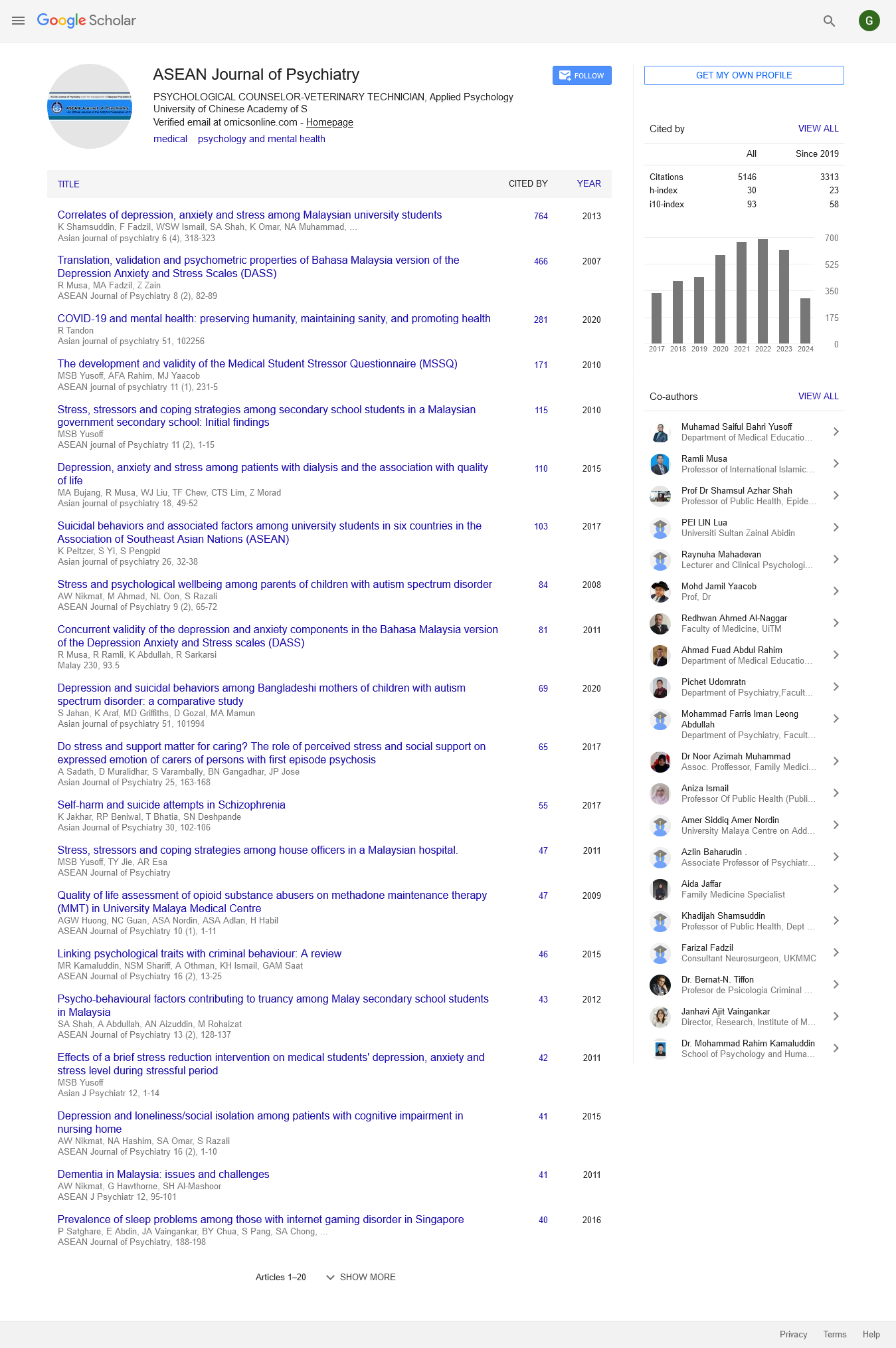
Google Scholar citation report
Citations : 5373
ASEAN Journal of Psychiatry received 5373 citations as per google scholar report
ASEAN Journal of Psychiatry peer review process verified at publons
| Journal Name | ASEAN Journal of Psychiatry (MyCite Report) | ||||
|---|---|---|---|---|---|
| Total Publications | 456 | ||||
| Total Citations | 5688 | ||||
| Total Non-self Citations | 12 | ||||
| Yearly Impact Factor | 0.93 | ||||
| 5-Year Impact Factor | 1.44 | ||||
| Immediacy Index | 0.1 | ||||
| Cited Half-life | 2.7 | ||||
| H-index | 30 | ||||
| Quartile |
|
- Anxiety Disorders
- Behavioural Science
- Biological Psychiatry
- Child and Adolescent Psychiatry
- Community Psychiatry
- Dementia
- Community Psychiatry
- Suicidal Behavior
- Social Psychiatry
- Psychiatry
- Psychiatry Diseases
- Psycho Trauma
- Posttraumatic Stress
- Psychiatric Symptoms
- Psychiatric Treatment
- Neurocognative Disorders (NCDs)
- Depression
- Mental Illness
- Neurological disorder
- Neurology
- Alzheimer's disease
- Parkinson's disease
Abstract
Comparing employer-based and employee-based Psychosocial Risk Assessment Approaches contributing to Workplace Stress and Occupational Mental Illnesses in Industrial Settings: A Systematic Review
Author(s): Mbaye Fatimata Binetou Rassoule*, Cisse Goumbo, Befene Catherine Noélie, Cisse Maimouna Fafa, Thiam Khady, Dia Kane Yacine and Toure Nafissatou OumarBackground: Occupational mental illnesses, including anxiety, depression, PTSD, and workplace stress, present serious challenges in industrial settings, making the identification of psychosocial risk factors critical for prevention and intervention. Employer-based and employee-based assessments are key tools for evaluating these risks, but their relative strengths and weaknesses remain inadequately explored.
Methods: A Systematic Review (SR) of database used: Scopus, Web of science, Cochrane library and PubMed was conducted using the Preferred Reporting Items for Systematic Reviews (PRISMA) technique. Keywords “psychosocial risk assessment”, “workplace”, “mental health risk assessment”, “employer evaluation”, and “psychometric evaluation” were used in this research. The inclusion criteria were: (1) Studies in industries involving psychosocial risk assessment, (2) English language, and (3) Research published in peer-reviewed journals within ten years (2014 to 2024). The EPHPP-Quality Assessment Tool was used to assess the quality of the studies.
Results: All 9 studies utilised employee-based assessments, highlighting gaps in capturing organisational-level stressors. Key psychosocial risks consistently identified included workload, low job control, role ambiguity, and inadequate support, which were strongly linked to adverse mental health outcomes. However, the lack of employerbased assessments limited the identification of systemic factors such as workload distribution and organisational policies.
Conclusion: The findings emphasise the need for a hybrid assessment model integrating employer and employeebased data. Such a model could provide a more comprehensive understanding of workplace risks and support the development of effective strategies to mitigate occupational mental illnesses, enhance employee well-being, and improve overall organisational performance.