
 +44 1752 712024


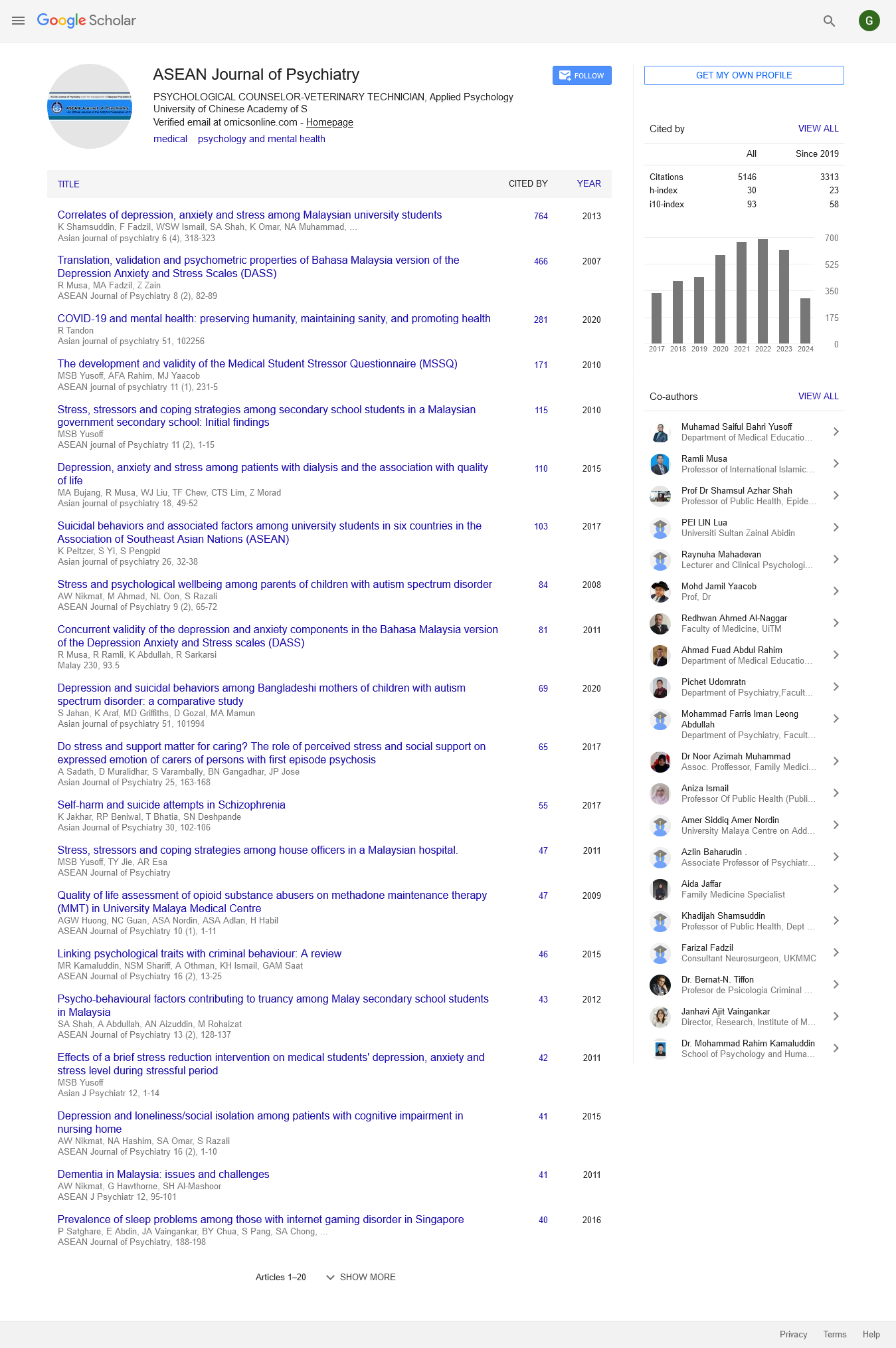
Google Scholar citation report
Citations : 5373
ASEAN Journal of Psychiatry received 5373 citations as per google scholar report
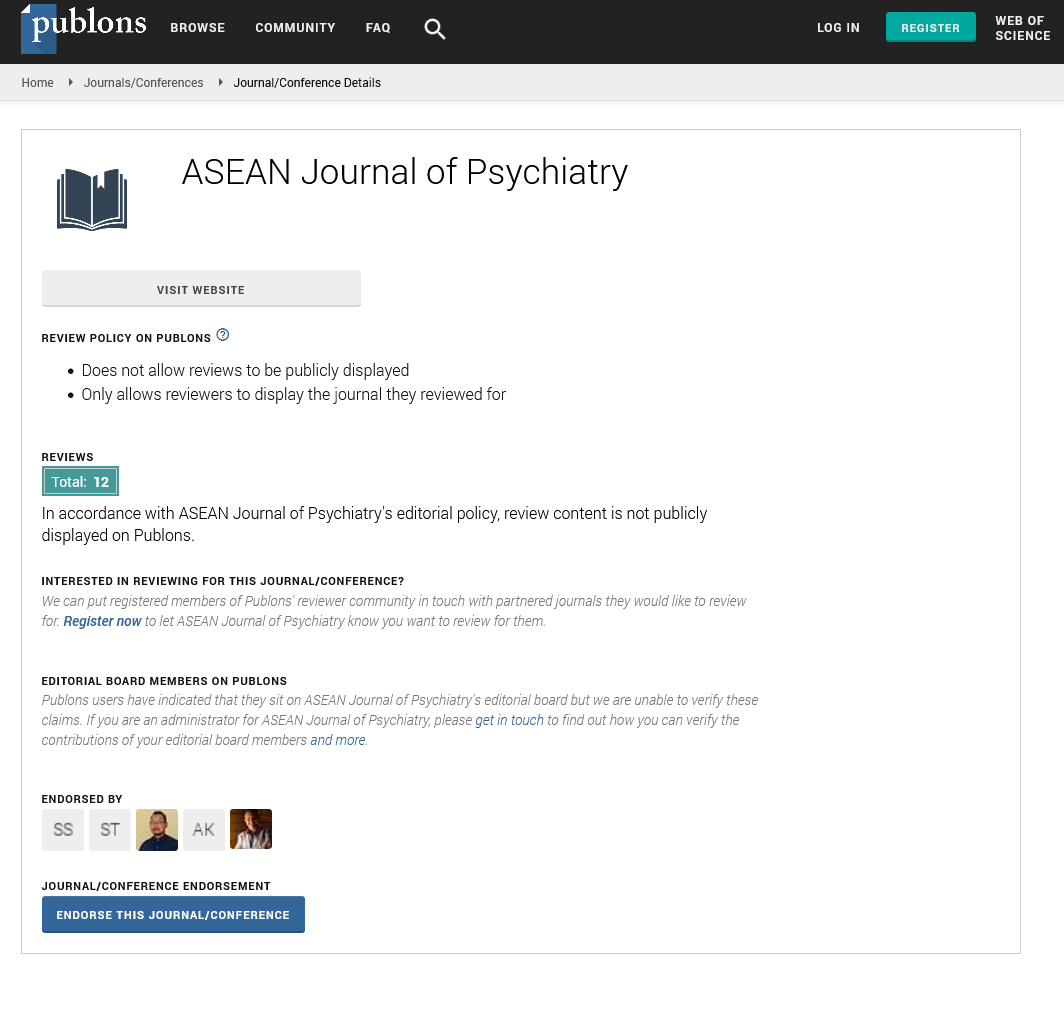
ASEAN Journal of Psychiatry peer review process verified at publons
| Journal Name | ASEAN Journal of Psychiatry (MyCite Report) | ||||
|---|---|---|---|---|---|
| Total Publications | 456 | ||||
| Total Citations | 5688 | ||||
| Total Non-self Citations | 12 | ||||
| Yearly Impact Factor | 0.93 | ||||
| 5-Year Impact Factor | 1.44 | ||||
| Immediacy Index | 0.1 | ||||
| Cited Half-life | 2.7 | ||||
| H-index | 30 | ||||
| Quartile |
|
- Anxiety Disorders
- Behavioural Science
- Biological Psychiatry
- Child and Adolescent Psychiatry
- Community Psychiatry
- Dementia
- Community Psychiatry
- Suicidal Behavior
- Social Psychiatry
- Psychiatry
- Psychiatry Diseases
- Psycho Trauma
- Posttraumatic Stress
- Psychiatric Symptoms
- Psychiatric Treatment
- Neurocognative Disorders (NCDs)
- Depression
- Mental Illness
- Neurological disorder
- Neurology
- Alzheimer's disease
- Parkinson's disease
Abstract
ANALYZING THE ROLE OF ARTIFICIAL EMOTIONAL INTELLIGENCE IN PERSONALIZING HUMAN BRAND INTERACTIONS: A MIXED-METHODS APPROACH
Author(s): Mojtaba Ghorbani Asiabar*, Morteza Ghorbani Asiabar and Alireza Ghorbani AsiabarObjective: This study investigates the role of artificial emotional intelligence in personalizing human brand interactions.
Methods: A mixed-methods approach was employed, combining quantitative and qualitative data analysis. In the quantitative phase, online interaction data from 500 human brands with their audiences were collected over 6 months and analyzed using machine learning algorithms. The qualitative phase involved in-depth interviews with 25 branding experts and 50 consumers.
Results: Quantitative findings revealed that the use of artificial emotional intelligence led to a 37% increase in engagement rates and a 28% increase in audience satisfaction (p<0.001). Thematic analysis of qualitative data showed that artificial emotional intelligence strengthens the emotional connection between human brands and their audiences by creating personalized interactions.
Conclusions: This research contributes to existing literature by presenting a novel conceptual model for integrating artificial emotional intelligence into personal branding strategies. It provides valuable guidance for professionals in leveraging emerging technologies to create more effective communications with audiences.